Farewell Friesen and Friesen

Dallas & Leanne Friesen

A couple of years ago my husband Dallas and I decided we would start a blog.  We were both pastors of our church at the time and it seemed like a good avenue to connect to our congregation, especially in a busy culture when people often have to miss our gatherings on Sundays. But one thing held us back.

What would we NAME this thing?

There are so many blogs with clever or insightful or meaningful names.  We couldn’t come up with anything.  Finally we decided to keep it simple: The Friesen Blog. friesenandfriesen.com.  Straight and to the point. And kind of cute, since we’d be writing as a married couple.

Since that time two years ago, a few unanticipated things happened.  The first was that the blog was read by more people than we ever imagined. We really did think it would be a blog for Mount Hamilton Baptist Church, with maybe a few others here and there.  After a few months, we were delighted that lots of our other friends, and friends of friends, were reading as well.  The second, for me, was the discovery that I loved blogging!  Pretty soon I was writing a lot more than just follow-up from Sunday sermons.  I wrote about my grief after losing someone I loved. I wrote about things I was learning as a parent.  I wrote about the things that were on my mind that mattered to me, or that I thought would make people smile.  This also meant that I was doing most of the writing (although for those of you who know us, the fact that I would have more to say than Dallas should come as no surprise).

After a while, people started calling friesenandfriesen “Leanne’s blog.”  Dallas didn’t mind.  Instead, he kept encouraging me to write more.  And share more.  And to get a twitter account already so I could tweet my posts!

But it was still nice to be known as “friesenandfriesen.”  Our unique mix of marriage and ministry was a lot of what made us “us.” And I did still get Dallas’ feedback before I posted almost anything, so that still made it our blog…right?

This summer when Dallas was called to a new position with our denomination, the question came up a couple of times: so what are you going to call your blog now?

This was a question I was not ready for.

For a few months, I stuck with the old title. It was safe and comfortable there.  I liked the cover picture.   People who followed it were used to the old name….and of course, what would I name this thing??

After a few months, I did make some updates.  I toyed with a new title, and I even taught myself how to update the formatting of the page.  But the domain name was still “friesenandfriesen.com.”  There was still a little trace of the original plan left.

Then a couple of months ago I got an email reminding me that the domain name would soon run out.  Friesenandfriesen was officially coming to an end (unless I wanted to pay some more cash to keep it).  Paying money for a name that no longer applied didn’t make much sense, but what SHOULD I call it?  Dallas helped solve the problem.  For my birthday Dallas bought me (what I thought) was a very romantic present.  My own domain name: leannefriesen.com

Why was this present romantic?  To me it said a few things:

  • I believe in you.
  • Your voice matters.
  • You can do this without me.

It’s that last one that I have doubted a lot over the past number of months.  When Dallas first left, I confess, I relished the challenge of proving I could do this on my own.

This has not been the experience I have had.

Instead, there have been many days and weeks where I felt as inadequate as I have ever felt in years of ministry.  I have been humbled, sometimes frustratingly so, by my own limitations. I have been more emotionally exhausted than I thought possible.  leannefriesen.com started to seem like a pretty bad idea.  Afterall, if I’m barely managing to keep my head above water as a pastor and a parent why would anyone want to read what I have to say?  And also, when do I even have time to write this thing?

What I have had to learn over these past number of months as the days of friesenandfriesen drew to a close is a simple, but painful truth: I CAN’T do this on my own.  But it’s not because I need Dallas.  It’s because I need God.

I cannot say it better than Douglas Coupland does in his book “Life After God,” when at the end, his character confesses to his readers:

Now, here is my secret…My secret is that I need God — that I am sick and can no longer make it alone. I need God to help me give, because I no longer seem to be capable of giving; to help me be kind, as I no longer seem capable of kindness; to help me love, as I seem beyond being able to love.  

I guess for me it’s not much of a secret, but these words are very true.  I have only been friesenandfriesen for a short while, but I have always been God’s.  And I have always, and will always, need God.

So now I am leannefriesen.com, which is more than okay.

Because I am not doing it on my own at all.

I hope you will keep reading at leannefriesen.com!

And share if you’d like your friends to read!

On Patience

It is actually a little off-putting to me how often the Bible tells us to wait.  “Waiting” upon the Lord is an invitation to trust God and God’s timing, but in my experience this is almost never easy to do.  I am not the first person to struggle with this.

This past week, I preached about Saul, the first king of Israel.  God chose Saul to be king, even though Saul was pretty hesitant about it. Even after he’d been anointed, he hid when it was time to be presented to everyone, and when he eventually did come out people still grumbled that he was the wrong guy.  Eventually, though, things went his way. He saved a bunch of his people from having an eye gouged out by an invading army, which is a great way to win friends and influence people.  Then everyone decided he was the bee’s knees after all, and threw him a big party.   

It would be really nice if I could say things were all uphill from here, but , regrettably, this is not the case. Sadly, Saul goes on to lose his Kingdom, and one of the first blows to his throne comes from his inability to wait.  

The story is told in 1 Samuel 13.  It says that the Philistines (Israel’s enemies) have “assembled to fight Israel, with 3000 chariots, 6000 charioteers, and soldiers as numerous as the sand on the seashore.” Saul’s army is pretty much freaking out.  A bunch of them have already left.  Lots of them are hiding (“in caves and thickets, among the rocks, and in pits and cisterns”).  The rest of them are with Saul at Gilgal, “quaking with fear.”  Knowing that the Philistines could attack any second, Saul has been waiting for Samuel – the prophet and priest – to come and offer sacrifices in order to ensure God’s presence with them.  It says he had waited seven days, as Samuel had told him to do, but Samuel has not come and the already terrified men are beginning to scatter.   

Can’t you almost feel Saul’s frustration?  His army is dwindling before his eyes, even as the Philistines are getting stronger.  He decides that he cannot wait one minute longer, and, although God’s laws absolutely forbid him to do it, HE makes the sacrifice.  Confession: I cannot say I blame him one little bit.

I often feel like Saul probably did.  I come to a situation where I feel urgency in my heart, a sense that I have to do something before things all fall apart. It’s not that I don’t trust God is looking out for me, except that I kind of don’t.  This is well illustrated by how I deal with something seemingly minor – answering emails.

I sometimes get emails (or facebook messages, etc.) that make me feel anxious. Perhaps the email expresses frustration with something happening at the church. Or it asks a question I’m not sure how to answer. Or it presents a scenario difficult to address. Of course most emails I get do not make me anxious, but once in a while it happens.  The interesting thing is that I’ve discovered that the greater the anxiety that an email causes me the faster I want to reply.  Why? It’s because I want to immediately fix it.  I want to make it better.  Something happens in my head that (falsely) tells me that if I just reply RIGHT NOW then it will be “dealt with” and my anxiety will subside.

It never works this way.

Instead, time and again, my quick reply only causes me more anxiety, as I then have to wait for a follow-up reply, or (most often) as some time passes and I think about what I SHOULD have said if I had just waited a little bit longer, when I was calmer, when I had taken time to pray, when I wasn’t driven by worry, but instead by God.  I almost always regret the email sent in urgency. 

It probably sounds silly, but I think that, for me, my challenge to wait on God is lived out more often in waiting to answer an email than in almost anything else.  Yes, this is embarrassing to admit.  Of course, I have waited on God for far more serious things – healing for loved ones, peace in uncertainty, answers to big questions. Yet, I can now see that the image of myself anxiously typing a reactionary email at my computer is not so different than the image of Saul standing over an altar making a sacrifice he shouldn’t make.  Both of us are failing to wait, to trust, to give God time to give us wisdom and peace.

For Saul, the consequences of his impatience are dire. As soon as Saul makes the sacrifice Samuel shows up and is grieved to hear what he has done.  Saul tries to explain it – he felt he had to.  He couldn’t wait anymore.  He needed to do something.  It is, however, too late.  His impatience has been his downfall.  Samuel tells him that because of what he has done his dynasty will not continue.  

The sad news is, Saul’s struggle is alive and well all around us.  We are an impatient people, and it hurts us over and over. Consider this:  How many difficult things do you know that could have been avoided if someone had just WAITED a couple of hours to calm down before posting a Facebook post?

I believe I have made my point.  

It may be that right now you are in a Saul-over-the-altar season.  You are waiting, and you want to be patient, but you can’t figure out where God is and you feel like  it’s time to do something.   Saul’s story again is a great reminder.  Saul thought he had to do something because he didn’t believe Samuel was coming. But you know where Samuel was when Saul made the sacrifice that lost him his legacy?  

Right around the corner.  

God hadn’t forgotten Saul.  God was working. Saul’s deliverance was on the way, literally about to walk up the road.

Do with this what you will.  

For me, it reminds me to choose patience.  And it reminds me that I can practice patience by doing something as simple as closing my computer screen after I receive a challenging email. I am still learning, but the great news is I know I will get lots more chances to practice. * 

May you too find ways to practice patience, and in so doing discover that God is not so far down the road after all.

(*Please do not send me fake angry emails to test me in this.  Real angry emails still accepted, but may not be answered immediately because see above). 

On “Adulting”

I have a confession:  I am completely and totally 100% okay with being called “ma’am.”

I believe I may be in the minority with this.

Today I turn 38 years old and once again I find the number before me a little shocking.  I remember when other people were 38 and they were definitely a lot older than I am now…right?

It’s ironic that my age surprises me because at the same time the idea of being a grown-up, and being treated like one, does not bother me at all.  I see and hear lots of comments these days about the perils and frustrations of having to “adult.”  I don’t know when “adult” became a verb, but I have to say I find it pretty funny – even though I disagree with the struggles usually applied with the term.

I see twenty-somethings discussing and sharing that “adulting” has caught them by surprise, that is harder and more difficult than they thought.  I see my peers sharing their regret that they have to “adult.” I see the general idea that returning to …childing?  or teenager-ing?  or adolescent-ing?  would be better or easier.

Friends, maybe it’s just me or the fact that I recently read through my teenage diaries in order to participate in “Grown-ups Read Things They Wrote as Kids,” but I will take adult-ing over the alternative EVERY DAY OF THE WEEK.  

Adulting is fantastic!!

Let me give you an example.

When I was 24 I went to buy my first car on my own. A friend came with me, also 24.  We went to dealership after dealership where we were ignored.  We would have to ASK for help every time and even then they sometimes ignored us.  And we let them!!  They were the “adults” in our mind, and buying a car was “adulting” stuff.

A few months ago when I went to buy a car, no one treated me like that anymore.  People came to talk to me.  When I had questions, they answered them.  And yes, they called me “ma’am.”  As they should!   I’m here to buy a freakin’ car for goodness sake!!!  Ma’am away!!

Let me give you another example. It is called “swimsuits.”

When I was  a teenager I laboured over what swimsuits to wear.  I wanted to be in style. I wanted to look good. I was so self-conscious in my own skin.

Now, with joy, I put on my swimsuit that cuts to the upper thigh and also has ruching in all the right places.  As a teenager, I would never have worn it because it wasn’t cool enough. I would have instead walked around awkwardly in a swimsuit that made me uncomfortable. Or worn a t-shirt over it.  Now, I go to the beach and see so many girls walking around self-consciously. Not me!!  I’ve got my lovable one piece and I don’t care if anyone looks at me funny.  Because I’m adulting.  And also no one is looking at me anyway (please note: they were never looking at me before either…something else that adulting teaches you).

Adulting is awesome!

With adulting comes confidence.  With adulting comes letting go of the belief you can be everything to everyone and being comfortable being exactly what you are when you need to be.  With adulting comes liking yourself.  With adulting comes responsibility, but along with that comes a sense of purpose and direction in your life.  

I loved a lot about my teenage and younger years.  There are things that I do miss about them.  But I am so happy to wake up each day and get to “adult.”  I get to come to work where God has called me.  I get to wake up with the man I married (marriage is another awesome example of an adult thing). I get to be a mom.  I get to decide what I want for dinner and when I go to bed.  

And sometimes I get to be called “Ma’am” by someone younger than me and I’m just fine with that.

This is what I think:  when they say Ma’am they say it is because they realize they are talking to an adult.  They don’t see me as their peer.  They see me as something different – because I am. I am not what I was then.  I have grown and I have grown-up –  things I hoped for back when I worried where life could ever take me.

If you’re younger and stepping into the adult world, don’t be afraid. Don’t fear adulting.  Don’t run from it.  Don’t dismiss it and don’t avoid it.

And if you’re adulting your way along, give yourself a high five!  Look at you!!  You are doing this thing!!!  I know it’s not always perfect, but aren’t you so happy that you no longer read “Sweet Valley High” books and wonder if everyone is having more fun than you? …(And can I just say: aren’t we all glad Facebook didn’t exist when we were growing up? *pauses for heartfelt Amens from all the adults who know exactly what I’m saying here…*).

Three cheers for adulting!
Today if I’m asked, “How old are you, Ma’am?” my answer is a simple one:   “38! …And it’s wonderful!”

“Do I Have to Ax the Elf??” and Other Thoughts on Teaching Children the Meaning of Christmas

As a Pastor and a mother, I am often asked about Christmas and what we do as a family.  This will be my ninth Christmas as a mother, and during this time we have developed a number of traditions and practices to help our children remember what Christmas is really all about.  I hope sharing them may be helpful to you.

Nativity Scenes

This one may sound obvious, but having a nativity set in your house is a great learning opportunity.  When our son was two, we purchased the Little People’s nativity set.  I can’t recommend these enough if you have young children.  It is great for children to be able to play and interact with the story.  The first couple of years we had it, he and I would often “play nativity.”  I’d say the story and let him put the pieces in.  By age 3, he could say the story of Jesus’ birth himself as he placed the characters in place.

nativity scene

One of my favourite things is how my daughter has started setting up nativity scenes.  Instead of arranging them like a display, she turns all the characters towards Jesus.  I think she’s got it right!  Kids can often teach us as much as we teach them.

Advent

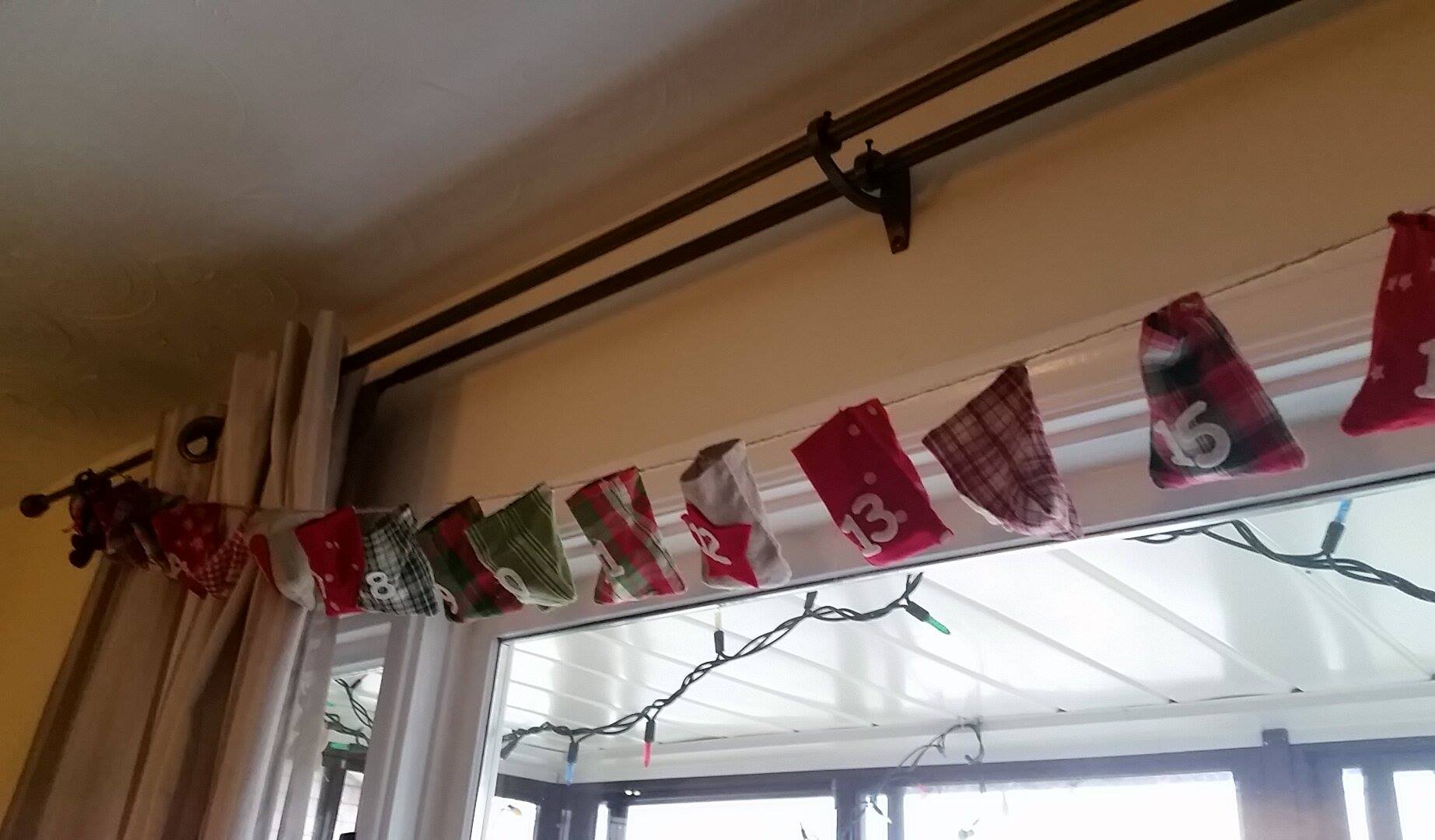
Advent is the season leading up to Christmas when we remember the waiting of those who waited for Jesus, and acknowledge our own longing for Christ to return. Almost everyone I know has an Advent Calendar – most often, the little ones you can buy with chocolate inside each day leading up to Christmas.  We have a reusable advent calendar (see below) that I fill with treats each year, and each night we “do advent” together.

advent callendar

 After supper, we read from an advent devotional book for kids (I will happily email anyone who would like a copy of this devotional).  Then we sing “O Come All Ye Faithful” or “Away in a Manger” – a carol about Jesus that the children know.  After this, they have their candy.  Our children love doing this and have been asking for days when we can start “doing advent.”

Birthday Cake for Jesus

On Christmas Eve, we make a cake together to celebrate Jesus birthday.  We sing Happy Birthday to Jesus and eat the cake.  This is a simple way to remind children why we celebrate Christmas.

Christmas Books

I am a real sucker for children’s books, and especially Christmas children’s books. One thing that is important to me is to have lots of books about the Christmas story.  These are easy to find (summer yard sales are usually stocked with Christmas books!) and a great chance for children to hear the story often.

I read an idea that we started last year.  I wrap up 24 of our Christmas books and they open one each day of advent for us to read together.  By making sure many of these books tell the Biblical Christmas story, we get lots of chances to tell the story again and again.

Focus All Traditions on Jesus

If you are a Christian parent, you may wrestle with what or how to integrate the many “other” traditions of Christmas that might seem to distract from its meaning.  Santa Claus and Elf on the Shelf are good examples of this struggle.  However, I believe we can enjoy traditions like these in ways that allow us to still focus on Jesus.

I am not going to get into the question of whether or not Christians should receive gifts from Santa.  I know Christians who choose not to use Santa with their kids, and it does not make Christmas any less special.  I grew up with lots of Santa and it did not destroy my faith when I found out he wasn’t real.  Zero judgement on either side here!  However, if you choose to make Santa part of your Christmas tradition, you can still make it about Jesus. We have taught our children about Saint Nicholas and where “Santa” came from.  We talk about how Saint Nicholas gave because he loved God.  It is not about whether they or good or bad (I really shouldn’t get started on this, except to say that it astounds me how people will talk about Santa in a way that they will later use as a reason they don’t like God, ie.  “I could never follow a God that judges people for how they live! But Santa?  I’m totally cool with teaching my kids that he only gives gifts to those who are “good” and not to those who are “bad.”  I don’t talk about God, or his followers – including Saint Nicholas – this way).   As an aside, we decided early on that we would not consciously lie in regards to Santa.  If our kids ask us a question such as “How Does he fit down a chimney?” we respond with: “That’s a great question. What do you think?”  On Christmas morning, there is one gift with a child’s name on it and no label of who it is from.  The kids draw their own conclusions! 

We also have an “Elf on the Shelf.”  Again, we personally never talk about the Elf as spying on them to make sure they are good (see above!).  We just have fun moving the Elf around. However, one of my favourite ways to arrange the elf a couple times during the season is to have her (ours is a girl) kneeling before Jesus in the nativity scene.  Again, this turns the focus back on Jesus.    

Giving

Like many at Christmas, we look for ways to help others.  We like to give through our denomination’s gift catalogue  (Share the link? Don’t mind if I do!https://secure2.convio.net/cbmin/site/SPageServer/?pagename=Gift_Catalogue_Home.html%E2%80%8E)  to help send children to school or provide goats or chickens for families.  We like to give food to our Christmas hampers in church.  We try to let our kids both see us doing these things and find ways for them to participate. If you give to others at Christmas, talk to your kids about it.  Integrate them in the giving.  Let them help pick the gift from the catalogue.  Take them shopping when you buy the food for hampers.  Let them see you put money in the “kettle” for the Salvation Army.  What they see you doing models to them what is important.

I’m not saying that we have it all figured out, but these are just a few ideas as the season starts.  I would love to hear yours – please feel free to share in comments other ideas about ways to help children remember the story of Christmas.

On Behalf of the Grieving at Christmas

Preamble:

I love this time of year – when the Christmas season is truly upon us.  When the lights start going up, and the Christmas music is on the radio and the Festive Special is back at Swiss Chalet.  I love Christmas!

Yet, as the season comes, I cannot help but think of those for whom it is painful.  I think of those who are facing that first Christmas without their loved ones, and my heart goes out to them.  I remember what that first Christmas was like for me, after my sister died.  I remember that everything that once made me happy at Christmas now made me sad.  I remember that the things I looked forward to were suddenly things that I dreaded.  

At the time, I didn’t have words to tell people what I was going through.  Today, two years later, I feel I can put words to what Leanne needed to say back then.  I couldn’t say it for myself then, so I hope I can say it for others now.

If you are grieving this Christmas, I write these words for you. Share them if you wish.  Or read them and know that someone understands, and that, in time, you will find your words as well.

And so, on behalf of the grieving at Christmas, I write:

Dear Friend,

I need to tell you that this Christmas feels different for me. Even though it may have been a while since my loved one died, facing Christmas without them is a new hurdle for me.  Facing Christmas feels scary because I don’t know what it’s going to be like.  I am afraid of all of the emotions that are going to come.  I am afraid of ruining things for others.  I’m afraid I won’t get through it.

I know that you care about me and want to help me.  First of all, know that there is nothing you can do to make this all better.  This season is hard because I am grieving and grief takes time.  But there are ways you can support me through this, and most of them are very simple.  Here is what I ask of you:

Be patient with me

I will not always be myself. I don’t know when it will happen. A song may come on the radio and you may notice that I have “checked out” as I step back into my memories.  I may see an ornament and it will make me cry.  I may see you with your mother, or sister, or father, or child, and that may be painful for me.  Give me time and patience.  I know I won’t be as fun this Christmas.  I hope you can understand.

Don’t Be Offended

Don’t be offended if I say “no” to things.  I may be ready to go to your party and then feel like I’m just not up for it. It’s not about you – at that moment a happy party is too much of a reminder of my sadness.  I may suddenly step out of a room because I need a minute to myself. I may need to leave places early.  Please don’t take these things personally.

Be Sensitive to Me

Be aware of what I’m going through.  Please don’t send me a Christmas card with a quick message at the end saying “Hope you have an amazing Christmas!” I probably won’t.  Please don’t talk to me about all my Christmas plans without acknowledging that I may be having a hard time. Be sensitive that this Christmas is not “just another Christmas” to me. It’s different.

Remember Me

You don’t have to bring it up all the time, but it will mean a lot to me when you acknowledge my loss. It doesn’t have to be a lot.  You can send me a note reminding me that you remember.  You can tell me when you see me that you are thinking of me and realize that this Christmas might be hard.  Pray for me.       

Don’t Give Up On Me

I know it’s not always easy being my friend right now.  I know living with my pain can be challenging.  At Christmas, it may seem easier to avoid me in my grief.  Please don’t.  I am doing my best, and even though I won’t always be the life of the party, I still need reminders of life, and hope, and love. Keep inviting me to things. Include me. Maybe I won’t feel up to it, but maybe it will be what I need most.  

Someday I will  figure out what it means to have a “merry” Christmas without my loved one, but this Christmas I don’t know it yet.  This Christmas I am grieving, and that is okay.  This Christmas I need some space for my grief.   

Thank-you for reading, because even reading this message shows that you care.   

Sincerely,

Your Friend Who is Grieving This Christmas

(For more thoughts on grieving or struggling at Christmas, you can read two of my blog posts from one year ago: “The Second Christmas After ”

http://friesenandfriesen.com/2014/11/30/the-second-christmas-after/

“The Trouble With Christmas Joy”http://friesenandfriesen.com/2014/12/18/the-trouble-with-christmas-joy/).

On Not Letting Fear Change My Mind

I am going somewhere with this.

Every few months our church hosts a “Welcome Lunch” for people new to our community. It is held on a Sunday after church at my house.  These lunches are usually very full, with the team of hosts and 15-20 newcomers each time we meet.  

This fall we selected a welcome lunch date for early October and as the date neared I grew concerned that we would not have anyone able to attend.  It seemed that every person new to our church in recent months was unavailable on the particular date we had chosen.  As we got to the Saturday night, and I was thawing a giant 20 pound turkey and taking out the big crock pot for the meatballs, I despaired that there would be no one to attend the next day.  I wondered if we should cancel, but I decided to pray instead.  

“God,” I asked.  “We have prepared a ton of food and we are ready.  You know who needs to be here tomorrow, so I leave it with you.”  

Interestingly enough, that particular Sunday my sermon was about the importance of welcoming strangers into our lives.  We were studying a story together about a time that two men (followers of Jesus) were walking down a road shortly after Jesus’ death when a man they did not recognize begins to walk with them.  They walk together, they talk, and eventually the two men invite the stranger to their house for food.  While they are eating, they realize that the person who has been walking with them the whole time is Jesus Himself!  They are overjoyed to discover He is alive.  In the sermon, I talked about how they never would have known they were walking with Jesus if they had not shown kindness to who they thought was a stranger. I talked about the reasons that we are sometimes hesitant to welcome strangers. Sometimes we are too busy, sometimes we are too self-righteous, and sometimes we are just plain afraid. I talked about how these were not good enough reasons.

Here’s a fun question:  What happens when you pray and ask God to send you WHOEVER NEEDS TO BE AT YOUR HOUSE the same week you prepare a sermon about not being afraid to welcome strangers?  

This is what happened to me.

A couple of weeks before this, a man who lives in a group home near our church began attending.   I was happy when I saw him show up that morning: “Yay!” I thought “That makes at least one!”  But then I saw something else. On this particular Sunday, he had invited THREE FRIENDS.  They were somewhat –  shall we say – rough around the edges. This did not bother me, or anyone in the church for that matter. Yet, while I was not afraid of these men, that day I was afraid of inviting them to lunch. The group home where I assumed they lived is very near my house – within walking distance – and I was afraid of letting these totally strange men know where I live.  I was afraid that they would start popping up at awkward times, asking for food, or for money.  

Full confession. I thought to myself “Maybe I won’t announce the lunch from the front….” I mean, I had said I was open and anyone could come, but these were extenuating circumstances, right? I have young children.  I need to protect my personal time at home. Perhaps this was a time to change my mind.

But I was about to preach a sermon about not being afraid to welcome a stranger, and I had prayed a prayer for God to send whoever God thought should be there.  

“Har! Har! Har!”  I thought.  “Well played, God….well played.”

So I invited them, slightly fearful and all.  Three of the four came.  As one walked in he told me: “I want you to know that I don’t do drugs anymore.  I stopped doing crack on FRIDAY.”  

“Excellent!” I told him, as I hung up his coat.

(“Could you keep a little eye on this guy?”, I whispered quietly to Dallas).

I took a seat next to them at our table and asked our friend who had been coming a few weeks: “Do you all live in the same house? Is that where you all met?”

He answered: “Actually I don’t know these guys at all. I only met them two days ago. They don’t live with me. He (motioning to guy next to him) lives on the street.”

At this, I could only laugh.  Once again, “Well played, God…well played.”

Then our friend said out of nowhere: “I feel really nervous.”

“Me too,” one of his guests said.  

“Is everything okay?” I asked.

“I feel like I don’t know what I’m supposed to do.  I hope I’m doing everything right,” said the first.

“That’s how I feel!” said the second

I smiled and assured them that they were doing just fine.  All they had to do was eat and enjoy themselves.

“It’s just….I’ve never been to anyone’s house for a meal before,” said the first, somewhat embarrassed.

“Me neither,” said the second, “This is my first time.”

I paused.

These were two grown men and in their whole lives they had never enjoyed a meal at someone’s house?  Never had friends to invite them over? Never known hospitality in that way?

It seemed God really knew the people who “most needed to be at my house” that day!   All I could think to say was:  “I am SO GLAD that you could be here today.”

And I meant it very very much.  

I was so thankful that I had not changed my mind about keeping the invitation open.  My fear had almost stopped me, it was true.  Perhaps if I hadn’t been ready to preach a sermon on the very topic, I would have let it stop me.  If I had, I would have missed out on what for me was a special moment.  It also turned out to be a great lunch, and I loved getting to know our new friends.  

Like I said, I AM going somewhere this. Here it is:

We should not let fear change our minds.

I am afraid of terrorists.  I am afraid of what happened in Paris and Beirut and way too many other places happening here.  It is scary.  Still, I do not believe fear is a reason that we should change our minds about what we need to do.  It was not a good enough reason to shut the door of my house and it is not a good enough reason, in my opinion, to shut the doors of a country – even for a little while.

I prayed: “God send people to my house,” and I have prayed: “God send refugees to safety.”

I don’t think I get to say: “But now I’m scared God, so I take it back.”  

Instead, as I pray for peace, I pray as well for peace in my own heart. I pray for peace in the midst of my own sometimes irrational, sometimes valid, sometimes functional, sometimes illogical fear.    

We can be afraid together and we can choose peace together.  It’s not necessarily a matter of saying we are not afraid.  It’s a matter of saying : “I will not let fear change my mind.”  

(P.S.  As yet, none of the guys has shown up at my house asking for food or money. Just seemed important to mention, no?).

Ninja Lice and Learning Lessons

When I was a young adult I spent several summers working at camp.  If there’s one thing you get pretty comfortable with working at a kid’s camp, its lice.  The first day of every camp involved a detailed lice check system and we all had to help out.  We got used to the “it’s nothing to be ashamed of” talk and gave it so often that we came to believe it in the very bottom of our hearts.  Which is probably well illustrated by the fact that I’m now writing a blog about lice this week.  “It’s nothing to be ashamed of!!”

Although every summer had its fair share of our little hair-clinging friends, it was the summer of 1998 that really took the cake.  Ah, 1998!  After doing one week at a camp off site, we came back to discover that EVERY STAFF MEMBER HAD LICE.  That’s right. Every single one.   After dropping a small fortune on lice shampoo, we all sat in lines like baboons combing each other’s hair.  We had to go into town and take over a laundromat so we could get all the laundry done.  It was kind of stressful, but mostly we just laughed.  What else was there to do?  And it didn’t end there.  Turns out that in the area that summer there was a strain of what the pharmacist told us had been called “Ninja Lice” that were resistant to treatment.  True story.  NINJA LICE.   We fought them hard all summer. Week after week.  I was treated NINE TIMES before I was finally clear.  I will tell you we grew to loathe those Ninja Lice, but it wasn’t all bad.  There’s few things that better teach you humility and community than when you have to let someone comb lice eggs out of your hair.  Each week, with each new check, I would have to say to someone again:  “Can you help me?”  while I had to sit there and let myself be helped.  And then I would have to do the same for someone else.  Comb comb comb.  Strand by strand.  Love love love.

This story is important for you to understand why I got an interesting phone call on Monday morning this week.  It was from a good friend of mine, who had worked with me at the same camp during the summer of the Ninja Lice.  (In fact, we shared a bed that whole summer, although she did insist that we sleep head to foot).  She had been having a bad day.  Her father had had a heart attack the night before and she needed to get to the hospital.  To add insult to injury, she had found lice in her daughter’s head that morning.

“Do you think you could come treat it and do the combing?” she asked me, “I know you know what to do.”

Of course I said yes.  Because sometimes when your friend is going through a hard time you help by making a meal, and sometimes you help them by doing some lice-combing.  Truth be told, I’m far better at the second.

“By the way, I told my daughter about when you had lice seven times, and that made her feel better,” she said.

“It was nine,” I reminded her.

“Even better!” she replied.

This was the point that I realized that I should check my kids as well, and you guessed it: two more lice cases.  I tucked my hair into a hat and we hopped into the car to have our little de-lousing party with our friend, which the kids thought was just the greatest.  Me? Not so much…but I as I learned 17 years ago – you might as well have a good attitude.

This is how I looked all day. Just more reasons to love hats!!
This is how I looked all day.

We made jokes and kept spirits up as my friend’s husband gave my son a buzz cut and I started shampooing the girls. It was a long day, with treatment, combing, second combing, laundry, an unrelated church meeting at my house, and a trip to the hospital to visit with my friend and her dad.  She dropped me off at the way home from the hospital.  As she did I asked her that very intimate favour we dread having to ask: “Can you check my head?”

And guess what?

TIME NUMBER TEN!!

Well, to be truthful, we weren’t entirely sure.  If anything it was a very mild case.  But as you can imagine, I wasn’t taking chances.  So after one more treatment of the day, I sat down in a chair and asked my husband: “Can you comb my hair?” While I may be one expert lice comber, I still can’t do it for myself. I needed help.

Such is the lesson I keep needing to learn again and again in my life.  No matter how much I think I can do it all, I can’t.  I put a lot through my hands this last Monday.  I admit, I was pretty proud of myself.  I kind of felt like a bit of a mom-ninja, taking on the task at hand.  I was DOING THIS THING!!   Then the day ended and no matter what else I may have been able to do I couldn’t do for myself what I’d been able to do for others.  Someone had to help.  I had to receive it.  And I even had to sit still while it happened.  Needy.  Dependent on someone else.  Vulnerable.

I actually hate asking for help. I hate needing help.  This has made this fall rather stressful for me because I have actually needed help a LOT.  Turns out that I can’t pastor a church on my own!

I am more surprised by this than I should be.

But it also turns out that when you are willing to ask, more people than you could ever imagine will be there for you.  You can plunk yourself in a chair and they’ll care for you in ways you could not have even dreamed.  They’ll step up.  They’ll care when you can’t.  They’ll visit.  They’ll plan. They’ll listen. They’ll support you.  They’ll even lice comb, if you ask.  Comb comb comb. Strand by stand. Love love love.

None of us can do life on our own. We weren’t even made to!  And just like I will reiterate time and again about lice:  Needing help “is nothing to be ashamed of!”

Hopefully, you won’t need Ninja Lice to remind you.

“But We Had Hoped…”

This is a post about what we do with our unrealized hopes. It seems like lately all I’m thinking about are the unrealized hopes of way too many people.

It’s been one of “those” seasons at our church, one of those times when you feel like you almost don’t want to check our Facebook page for fear of what you will hear of next.  There have been so many sad things.  Not one but TWO little boys fighting cancer, with grandmas and families that are part of our community.  Another church member, a mother of two, facing a continued cancer journey.  More people who have lost loved ones than I can list in the last few months, and so many of them tragic.  And then there are of course the lost jobs. And people with depression.  And sickness.  And infertility. And ongoing health struggles.  

This week in our service we looked again at a story we’re studying together this fall, known as the Road to Emmaus (if you are from MHBC and feel well versed in this summary, feel free to skip to the next paragraph…).  This story (found in Luke 24) takes place on the Sunday after Jesus died. It says that two of his followers are walking on a road to another town when a stranger comes up and begins walking with them.  Now, we are told as the readers that the person walking by them is actually Jesus, but they don’t know that for a while.  They think he’s just some guy walking with them.  They tell this man what had happened in their lives in the last little while. They tell him about “Jesus of Nazareth,” a “prophet, powerful in word and deed before God and all the people.” They explain that Jesus had been executed just a couple of days before and then they say the really painful thing: “But we had hoped that he was the one who was going to redeem Israel.”

There it is:

But we had hoped.

Here is what happens when I read this story to a church full of people I love, many of whom I have known for a while now.  I look around and I can see and I can hear and I can name the “I had hoped” story on so many of the faces. And my heart feels like it could break.

This story of disciples walking on a road, walking away from the city where their hopes were destroyed, naming to a stranger their defeat and their heartbreak, is not so different from a whole lot of our stories, even if it happened 2000 years ago.  Most of you have been there.  Walking away from the hospital. The doctor’s appointment.  The graveside.  And if someone were to ask you at that moment, you would have your story, too.  “But I had hoped….” 

I would get better. 

The treatment would work. 

I would be pregnant.

He would live. 

So here’s this room full of unrealized hopes. And me at the front with a passage to teach.  What is there to say?  This is what I said this week, inspired by the example of these two disciples and friends from 2000 years ago, about what we do with our unrealized hopes.

  1. Name and Lament

This is a message that I want to say loud and often.  You are ALLOWED to be disappointed.  You can name your hurt, your pain and your discouragement.  You don’t even have to make it sound pretty and you certainly don’t have to try to put a good spin on it.  The disciples didn’t.  They just call it what it was.

“Jesus died.  But we had hoped in something different.”

“This isn’t what we wanted to happen!” they declare.

And in the light of our unrealized hopes, we need to declare it too.  We need to name it.  Own it.  Put our finger on it.  Say it out loud.  Tell it to God, and to anyone else you feel like, too.

This lets us lament.  Lament is when we say what we are sad about and let ourselves be sad.  I’m certain the disciples were sad because it tells us:  When Jesus asked them what they were talking about it says: “They stood still, looking sad.”  

Sometimes, we pause, stay still, and let ourselves be sad. It’s not only okay – it’s necessary.

  1. Discern our Desires

There is, however,  another step.  It may take a while to get there.  The lament phase can be long, and you may bounce back to it often. This is normal.  But when you are ready, when the lost hope has been named and the pain has been grieved, we begin to ask:  “What was God doing?  What is God still doing?  Where is God in this?”

This happens in short order for the disciples in this story. After they spew out their story of loss, Jesus (who they still think is some stranger) begins to teach them.  It says “He explained to them what was said in all the Scriptures concerning himself.”

They thought all their hopes were over. They thought Jesus was dead.  What else could be the case?  But turned out Jesus had to die, in order for the much bigger thing that God was doing to happen.  And Jesus helps them see that. He helps them discern what is really going on in the midst of their unrealized hope.

As we discern, we may realize that some of our desires had to die to make space for what God has planned.  That break-up needed to happen.  The self-motivated dream had to be replaced.  Or we may discern that in the midst of great loss God is giving opportunities for redemption.  We begin to see the ways God has been with us or what we are learning.

This is the cool thing about this story.  The men were despairing because Jesus was dead but it turned out Jesus was walking beside them on the road.  They just didn’t understand yet. 

  1. We hope

After they are awed by the stranger’s teachings, they insist that he come to their house to eat.  Then they see it – the stranger is JESUS and he is ALIVE!!  As they finally see the full story, they are transformed from people of defeat to people of joy. They run back to Jerusalem to tell everyone the great news.  

What had happened on Friday hadn’t changed.  Jesus HAD died.  But what had changed was that they saw the full story, and that made a big difference.  They could hope again.

We can too, as hard as that may be to believe. We can hope when we remember the full story. 

And the full story is that Jesus IS alive and HAS defeated death and that God is still working for the redemption of the whole world. We already know the end to the full story.  That no unrealized hope will be wasted.  That no pain will last forever. That one day, we will gather at a table with Jesus and see it all, too, and it will be quite the party.

Perhaps it does not feel like enough.  But that’s what I told everyone this past Sunday morning.

Lament. Discern. Hope.

Repeat as needed.

Are My Shingles Trying to Tell Me Something?

On Saturday, I woke up with this funny pain in my left side.  I couldn’t describe what it felt like. It was sort of tingly. But sort of burny.  And sort of stabby.  I decided that I slept on it funny and had maybe somehow pinched a nerve while I was asleep…or something?

The next day it still hurt, and I still couldn’t describe it.  The pain seemed to be spreading.  Then I noticed that I had a rash on my back.  I went to my doctor on Monday who immediately said “That’s shingles.”

She explained that shingles is a version of the chickenpox virus; if you have chickenpox at some point in your life then the virus is in your system and it can be triggered later in life.

“So why did I get it now?” I asked her.  “What triggered it?”

“Stress,” she answered, without missing a beat.

I found this rather bothersome.

I have spent the last few weeks telling those who ask that I am not stressed, even with all the change going on in my life.  With my husband beginning a new job, I have more responsibility at home, and considerably more responsibility at my church, where I am now serving as pastor without him.  But, honestly, I feel like things are going pretty well! I have lots of support. I’m enjoying myself. The church is healthy, and moving forward.   

But here I am with stress-induced shingles, which I find very offensive.

Don’t the shingles know that I have been very intentional this year in developing a schedule that lets me have down time?  That I have said “no” to a number of opportunities? That I’m even taking a Sabbath?   

I guess no one told them.

My head be like: “You got this girl!”  

My shingles be like: “Nope.”

I don’t really know what to do when my body tells me something with which I disagree.

Here is what I do know:

One.

I have shingles and they are painful.  Whether I want to or not, there are things I can’t do this week.  Like walk a lot.  Or sit in my chair a long time. Or go visit a newborn baby from our church (sad face!).  Like it or lump it, this week I have to rest.  I AM LISTENING SHINGLES!!!!  

Two.

Rest is important, whether or not your body uses shingles to tell you so.

We are rarely given permission to slow down.  We are rarely made to feel valuable if we are not contributing.  We are told that we must do more, produce more, be more, give more, help more, work more, serve more.  But that voice is not the voice of God.  Jesus said:  “Come to me, all of you who are weary, and I will give you rest.”

He didn’t say: “Come to me and I’ll help you get your stuff done.”

He didn’t say: “Come to me and I”ll help you organize your schedule.”

He didn’t say: “Come to me and I will help you develop a meal plan.”

He said to come and REST.  

What’s funny is that we can find the invitation to rest as irritating as shingles sometimes.  Our identity is so deeply wrapped up in what we DO that the invitation to stop doing – for even a little while – can make us feel itchy and uncomfortable.  When did being told to rest become such an insult?  

I’m still not sure I entirely agree with my shingles.  They haven’t convinced me my stress is out of control.  But they have reminded me to sleep, and to pause, and to walk a little slower.   
Which are probably decent lessons, so I’ll take them.

Come, Just As You Are OR Don’t Be a Lightning Strike

“You don’t want me at your church!  Lightning might strike when I come inside!”

Thus goes the joke that I’ve heard more times than I can count.

Sometimes it’s after I’ve invited someone to join us on a Sunday.  Maybe we’ve been talking about God and it’s obvious they’d like to talk about it more.  Maybe it’s a friend or neighbour who asks what our church is about.  Or a family from camp whose kids have had a great time all week, so we tell them they are welcome back. Nervously, they joke:   “I don’t think I should come on Sunday – lightning might strike!”

It’s actually kind of funny how often I hear this joke.  Especially since, from what I’ve hear, lightening has never actually struck a church when someone sinister has walked inside.  It’s never struck when I’ve walked inside a church either, which I think is equally impressive.

The thing is, though, no one actually believes lightning will strike if they walk into a church.  But there is a fear there.  The fear is the “lightning strikes” that might come from the people of God.  They can be considerably more painful.

I can tell more stories about those kind of strikes than I care to remember.  The teenaged girl told she should be ashamed because she was wearing a shirt deemed too short. The woman who was asked to stop bringing her child after a few weeks because he had special needs and was “too disruptive.”  The man who was shunned after people discovered he had a criminal record.  I make none of these up.  

Then there are the people who are told they are too dirty or too different or too divorced or too loud or too gay or too female or too sinful or too didn’t-grow-up-in-this-church or too wearing-a-baseball-hat to be able to seek God in a certain church community.  Strike, strike, strike. Is it any wonder people are afraid of church lightning?

This is why I really like the motto that has been adopted at the church I call home: “Come, just as you are.” I preached about it this Sunday (you can hear it at http://podcasting.mhbc.ca/11600-2015-09-13+Leanne+Friesen.mp3).

After this sermon, I heard story after story of “church lightning strikes,” like the ones above.  Now I’m starting to think that one important way people can live into the motto of “come as you are” is actually very simple: do what you can to avoid being a lightning strike.

You want to make a comment about what someone is wearing? Or the coffee they’re carrying?  Or the noise their child is making? Or the seat they’ve chosen to sit in?  It feels incredibly important to tell a guy to take his hat off, or to scowl at someone smoking outside the door? Just – don’t.  Sometimes saying “come as you are” can be as simple as saying nothing when you really feel you “just need to say something.” Make sense? 

This is not to say you should not speak to someone you recognize as new to your community. Definitely say something… but may I suggest choosing from these options:

“Welcome!”

“I’m glad you’re here.”  

“Nice to meet you.”

“What’s your name?”  

“Do you need help with anything?”  

“Would you like to sit with me?”

Less lightning. More love.

Come, just as you are.