My Rant About “Dying With Dignity”

This week when I preached I went off on a little bit of a rant.  I have had a lot of people since speak to me about said rant, and their appreciation for it, so I thought I would share it with you on the blog. This is rather more controversial than I usually lean here, which makes me anxious, but here I go…

The rant revolved around the current discussion in our culture regarding the legalization of doctor assisted suicide.  Now, obviously, I could spend quite some time talking about the nuances of that situation, and my own beliefs about it, but that was not what my rant was about.  My rant was about the phrase, often used by those in support of doctor assisted suicide, “dying with dignity.” My rant is about what the opposite implies –that those who die difficult deaths are somehow “undignified” by comparison.

A few weeks ago I heard a woman explain it just this way. She was being interviewed on a radio show about her own mother’s wishes to be able to end her life before her disease took its full course.  She said something like: “At the end my mother couldn’t do anything for herself. She had to depend on others.  She was in pain.  It would’ve been nice if she could have died with dignity.”

I sympathize with this woman, truly.  Watching your loved one die and suffer is something for which you can never be prepared and harder than you could ever imagine. But I must respectively disagree with her choice of language – because I do not believe her mother died without dignity. I do not believe that being in pain or needing others removed the dignity from her death, because I see neither of those things as “undignified.”

Instead, I agree with Amy Plantinga Pauw who wrote this some years ago in an essay called “Dying Well: “What does dying well mean for those who suffer “bad deaths” and for the loved ones they leave behind? Here the fact that dying well is not an individual practice but a shared one is especially significant…”

A shared experience.

That is not the same as an easy experience.  It is profoundly difficult to share the journey to death with someone. It is difficult to watch them lose their abilities, their independence, their sense of self.  I can only imagine how hard it is on the one who is dying.  But I do not believe it is undignified.

I do not believe it is undignified to need others. I do not believe it is undignified to allow yourself to be cared for. I do not believe it is undignified to come to the place where we can survive only if we have others.

Nor do I believe it is undignified to be in pain.  Of course, I do not wish pain on anyone.  When I remember back to the last days of my sister’s life, one of the most difficult memories for me is the way that she would wince in pain.  Because she died of melanoma, at the end her body was covered with open tumors – and they hurt. She had several tumors on her head and each time she would move, she would wince.  It was awful.  Even as I remember it now, tears come to my eyes.  The memory of that wince haunts me sometimes.  I would have loved to have taken it from her.

But let me be clear – I don’t think it was undignified.  It was hard and it was awful.  But in every wince and every moment, there was never a loss of dignity.

As a pastor, I have journeyed with more people towards death than most people my age. I have seen peaceful deaths and I have seen hard deaths.  I have sung over people in their last moments as they slipped peacefully to eternity and I have prayed for comfort through pain for those that struggled to the end.  I have wished for things to be different and I have been thankful for what it is. And I have seen dignity.

I have seen dignity in people willing to be led, and held, and nurtured as they give their loved ones the gift of caring for them.  I have seen dignity in people who face the end and say “I am frightened,” and I have marveled at their honesty.  I have seen dignity in those who have said “I am not afraid,” and I have marveled at their faith.  I have seen dignity in people who are drooling. And wearing adult diapers.  And catheters.  I have seen dignity in people who say embarrassing things because they are full of pain medications and dignity in people who can no longer speak.  When I have seen someone in a vulnerable moment in their final days, I have never thought:  “If only they had dignity…” I have thought: “God is here.”  “I hope I can have such strength.”  “Thank-you God, for this person’s life.”

The real truth is that the greatest dignity I have seen in death is often in those who have suffered most, as impossible as that might seem to those of us who have not yet suffered.  I only wish that more people had the opportunity to sit at deathbeds and see the dignity that comes to those that endure.  It may not be pretty – but it is beautiful.

Now, I know there will be many views about doctor assisted suicide among those who read these words.  And I do certainly understand that it is out of compassion that many of you will argue in favour of this cause.  I understand that you do not want people to suffer needlessly.  I understand that you are operating out of love, and not hate.

And so, I appeal to your sense of compassion and love – stop calling it “dying with dignity.”  Call it doctor assisted suicide. Call it euthanasia.  Call it end of life decision making.  Make your points and your arguments and see where we all land.  But no more “dignity” language – please.  No more implying that those who suffered or those who needed to rely on others or those whose final days were messy and painful died without it.

Language is important, so, please – give the dead, the dying, and those who will die someday in ways that are hard the dignity of a rightly named death.  Perhaps they have died differently than seems fair or reasonable, but they have, indeed, died well.  They have indeed died with dignity.

Thus endeth my rant.

The Year I Read 40 Books and What I Would (and Wouldn’t) Recommend

At the beginning of this year I was talking to a friend who shared that a Christian speaker he admires reads forty books a year. I admit I was not that impressed. “Forty?” I said. “I’m sure I read forty books a year!” I love reading, so when I did the math, realizing that was less than a book a week, I was confident I could do it. It became my New Year’s Resolution to write down the name of each book I read, as well as a little write up about it so I could reference it later. And, secretly, I also hoped to hit the forty book mark.

I’m happy to say that last night I finished book #40. I don’t share this here to boast. (Keep in mind that my book-reading is often in lieu of other good things. For example, exercise). The reason I share is because I thought that I could share some recommendations coming out of those 40 that might be useful to others.

For each book, I gave a rating out of ten. The books I share here actually are not all ones that I necessarily give the highest rating; they are books that I think are valuable and that I would recommend for different reasons. So here goes – hope you find a category that is helpful for you!

The Book That Every Pastor (and Human) Should Read – The Etiquette of Illness (Susan Halpern)

This is not a Christian book, but it is one that I think EVERY PASTOR (or caregiver or, as said, human) should read. It is written by a woman who has much experience in palliative care. She shares how we should respond to people who are sick or dying and it is packed with practical wisdom. My favourite tidbit from the book is her invitation to shift from asking a sick or struggling person “How are you?” (putting pressure on them to respond, make you feel better, say more than they want…) to asking “Would you like me to ask how you are doing?” I have seen the power of this shift – it allows you to show someone you are concerned without putting pressure on them to talk. It’s not the best written book I’ve ever read (I gave it 8/10 for that reason), but it’s so useful and practical. READ IT!

The Book That Every Christian Parent Should Read – Spiritual Parenting (Michelle Anthony)

I loved this book. Parenting books are so tricky, aren’t they? Especially Christian ones! It’s hard for us not to feel like failures when we read them and the other parent seems sooo perfect (or at least thinks they are!). Although there were moments where I felt that reading this one, in general I found the author to be humble and genuine, and the lessons of the book were powerful. My favourite lessons were the reminder to look at each child you have and to be the parent that God needs you to be for THAT child instead of picking a parenting philosophy and trying to fit your kids in (Insert MIND BOGGLE!). Her chapter on discipline is also, in my opinion, the best reflection on this I’ve ever read (and I have a degree in Child Studies, so I’ve read a bit!). Her invitation to see discipline as an opportunity to show God’s love and to bring healing was amazing. The Mom’s Group I lead studied this book in the spring and appreciated it as well. (I gave this book 9/10)

The Book That You Should Read if You Have a Son – I Don’t Want to Talk About It: Overcoming the Secret Legacy of Male Depression (Terrence Real)
Written by a therapist, this book explores the reality of men who struggle with depression and wrestle with their self-worth. It connects much of this to the way men and boys are raised to put on a strong persona and keep their emotions internal. It is not a parenting book; in fact, it is more designed to help men and those who work with men make these connections. However, I thought it was very insightful as a mom of a boy. I was challenged to think of the ways I nurture Josiah and the space I make for his emotions in a healthy way. One study that he references said that almost all parents show more physical affection (hugs, kisses, cuddles) to their daughters than to their sons. I realized this was often true of me. I have since made sure to have a “one to one” hug rule (one hug for Lucy, one for Josiah!), even if he pushes me and says “Mom! I’m too big!!!” The book, I would argue is longer than it needs to be and relies more on regression therapy than I would prefer (I gave it 8/10 for this reason), but it is a great book for those of us hoping to raise healthy boys.

The Book to Nurture Your Soul – An Altar in the World (Barbara Brown Taylor)
If any of you read this blog, yes, this is the same Barbara Brown Taylor in front of whom I forgot my Scripture reading 11 years ago. The good news is, she has not yet told that story in one of her books, from what I can tell. I actually read three of her books this year, and the other two, I did not love (“Learning to Walk in the Dark” just did not resonate with me in the same way and I was ultimately disappointed in her conclusions in “Leaving Church”). But this one – I loved. The book is about finding God’s presence in the world around you. It spoke to my heart. She talks about spiritual “practices” such as “the practice of wearing skin,” “the practice of saying no,” and “the practice of feeling pain.” It’s good stuff. (I gave this book 10/10, one of only two this year!)

The Book That I Recommend to Christian Feminists – The Many Faces of Martha of Bethany (Diane E. Peters)
This one was a surprise treat. I had been given it as a gift many years ago, but had never actually read it. This year I was speaking about Martha at a retreat and I started to flip through it for some background information. I ended up reading it cover to cover in a day. It goes through the history of how the biblical character of Martha has been understood from the early church until today. What a joy to discover that this woman who I often find myself aligning with in a negative way – as a woman distracted, focused on the unimportant, missing Jesus – has throughout history been celebrated and revered in ways I never understood. Worth it just to learn the story of Martha and the dragon (Gotta love a woman taming a dragon with a girdle…). 9/10 for me.

The Novel I Loved the Very Most – Peace Like a River (Leif Enger)
I want to say here that I LOVE NOVELS. In fact, half of the books I read this year were novels. Some were great, some were…blah. It’s always a bit of gamble how a novel will turn out for me, because my favourite method of attaining them is to go to Bibles for Missions behind my house and buy them for 50 cents and then return them when I’m done. I end up with whatever they have, and they are usually books I’ve never heard of. The great joy of this is when you find a book this way that you end up falling in love with. That’s what happened with this one. I had never heard of it, but it had good reviews on the back so I bought it. It was one of those books that when I was done I had to put down with reverence and sit for a few moments. The plot is hard to summarize. This is what Amazon says: “Young Reuben Land has little doubt that miracles happen all around us, suspecting that his own father is touched by God. When his older brother flees a controversial murder charge, Reuben, along with his older sister and father, set off on a journey that will take them to the Badlands and through a landscape more extraordinary than they could have anticipated.” This is not a “Christian book,” but God is indeed all over this book, friends, in a way that is real and genuine. I always feel sad when other pastors tell me they don’t like to read novels. They miss some of the best stuff, and this book is an example. (9/10 from me on this one).

Other Highlights

Favourite Book Co-authored by a Family Member – The New Parish (Dwight Friesen, Paul Sparks, Tim Sorens)
More importantly this is a tremendous book on neighbourhood engagement and I highly recommend it.

Favourite (Unexpected) Book About Grief – February (Lisa Moore)
This is a novel from the perspective of a woman who lost her husband during the sinking of the Ocean Ranger. Not only did I love its Newfoundland setting, it names and explains grief in a way no text book ever could. I felt like writing Lisa Moore a thank-you note.

Other Christian/Theology Books I Loved:
– Incarnate (Michael Frost) – I blogged about this a while back
– Living at the Crossroads (Michael Goheen and Craig Bartholomew) – Helpful book about Christian worldview
– Playing God (Andy Crouch) – this was my other 10/10. But it’s a really dense read so it’s not one I recommend to everyone.
– When Helping Hurts – An invitation to consider what it really means to “help” those in need; a challenge to us to see past our desire to give “charity,” which often does more harm than good.
– Practicing our Faith (Dorothy C. Bass – Editor) – A series of essays on faith practices. Many rich ideas.

Other Recommended Novels
– The Dinner (Herman Koch) – This novel has that “Lord-of-the-Flies-humanity-is-dark” feel. It will dig into your brain and stick for a while, so be prepared.
– The Forgotten Garden (Kate Morton) – There is no deep underlying meaning or message in this book. It’s just good, and I couldn’t put it down.
– Bread and Bone (Saleema Nawaz) – I got this one off the list of “Top 100 Canadian Books.” It’s about two sisters, and their struggle to find meaning and peace as they grow into adults.

Well there are a lot more that I could write about, but I will end here. Hope that my year-long project has been helpful to some of you. Happy Reading!

I Give Up On People

Well, I’ve got to be honest, it’s been one of those weeks where I feel weary. My guess is I’m not alone in this one. A lot of hard things have happened in our country and in our city and in the day-to-day lives of people I care about. It felt like one of those weeks where I heard one yucky story after another, and where I wasn’t sure I wanted to hear anymore. And it was one of those weeks where people started to wear on me, or something.

A gunmen attacks an unarmed soldier in Ottawa. It’s heart-breaking, and it’s scary. And then there are the Facebook posts: “If you don’t like this country – go home! Like if you agree!” And people liked it – they surely did.

Our municipal election was happening, and I was part of an online group that seemed to get nastier and nastier. People saying terrible things about people they had never met, sweeping statements about the character of candidates, sometimes downright lies…I would just stare in shock some days as I read words written by people who I’m certain are great people in real life, but were awfully internet-cruel.

And then one of my favourite radio hosts declares that he’s been unjustly fired because of biases against his personal sexual tastes – and without even hearing a hint of the other side, thousands of people jump to his defense and lambaste his employers and his accusers. Our country united in grief just a few days before is divided over a radio show host. “How dare the CBC do this??” “We love you Jian! “ “You said it first so your story must be TRUE!!” I watched online comments sections like a car accident from which I couldn’t turn away.

(As an aside, while I reserve judgement until we know the full story, I will say this: If a guy admits that he gets off on punching a woman in the face, whether or not it’s consensual – I no longer find his voice soothing on the radio).

In the midst of all this, someone shared a status of a guy dressed as the football player Ray Rice (of beating-up-his-girlfriend-in-an-elevator fame…) standing next to a girl sporting a fake black eye – as a cute couple’s Hallowe’en costume. The disgusted caption was “I give up on people.”

Finally, I found something on the internet with which I could agree!

Sometimes, I just don’t get it. And this was one of those weeks where I felt just like that: “I give up on people!” I give up on people verbally attacking people they don’t know on a Facebook page. I give up on people judging a whole faith by the actions of one deranged gunman. I give up on people justifying violence against women because they like a radio talk show. Ugh. What is wrong with us???

Then, even as I type, I pause and hear my own voice. My own judgemental voice condemning people I don’t know. My own voice saying “How can people be so stupid?” My own voice saying “Why can’t people think like me?” And, well, isn’t that where the problem starts?

Then I hear another voice – a voice of wisdom that I heard this week. The question was asked how we find the space in our hearts to truly love others. “It begins,” he said, “at the foot of the cross. It begins when we picture ourselves there and see our own selves at Jesus’ feet, with all the ways we fail, all the things we’ve messed up, all the things we try to hide – and realize Jesus is on the cross for us still.” If I may summarize – it begins when we see the One who has not given up on us.

Thank God, he has never given up on me. Who on earth am I to give up on the human race?

Maybe, instead, I’ll just give up reading comment threads…

The Day I Almost Cut Off My Finger Preparing Communion

Okay, so I didn’t almost slice it off.

But it did really hurt!

Many of you will know (thanks to my Facebook update AND my announcement at church on Sunday…) that on Sunday morning while I was cutting up the bread for communion that I cut my finger. Badly.

Dallas had already left for church. I was multi-tasking, making pancakes for the kids and slicing this big loaf of bread while they cooked. Somehow, my finger slipped in where the bread should have been. Instead of sawing it, I sawed the finger. I swear I heard the bone scrape, hand to Heaven. So then I screamed. And then I had to act all calm because the kids were there and I didn’t want them to freak out. “I’m okay! Mommy’s fine! Mommy just cut her finger!” I told them, as I flipped the pancakes with my other hand. Then I realized I needed to sit down. Fortunately for me, our recliners were in the kitchen, since Dallas re-did our living room floors this weekend. It’s nice when things work out like that.

I reclined while the kids happily ate their pancakes and I held my finger as tight as I could with our now-ruined tea towel since I knew as soon as I let go, that sucker was going to bleed something awful. I could not believe how much it hurt. I kept thinking of mob movies where they cut off people’s fingers and how awful that must have been for those poor people. Then, as I saw the blood start to seep from my hand, I thought of something else.

“This is my blood of the covenant, which is poured out for many…”

“This cup is the new covenant in my blood…”

“Jesus blood was shed for you…”

I have often said to student ministers: “Sometimes you get to the end of a week of ministry and you think: Why am I doing this? And then you share in communion. And one by one people come forward and you say “This is His body…this is His blood…And you remember: “This is why.””

And it is good.

The irony of my hand bleeding as a result of communion was indeed not lost on me. And I promise I am not making this up as some devotional illustration after the fact. I really did sit there in my recliner in my kitchen with the pancakes cooking and the kids asking for juice and my tea towel starting to ooze and think “I am thankful for what Jesus did for me.” I cut my finger and I had a God moment.

Eventually, the bleeding got under control. The only medical supplies I could find were kid’s Polysporin, a piece of gauze and scotch tape, so I haphazardly wrapped my finger with my functional hand, and proceeded to church where I was thankful for the church’s recently stocked First Aid kit, Amanda for stocking it and Christy for re-wrapping me properly.

Now, to follow up to the questions that I have since been asked:
– No, I did not get any blood on the communion bread (Thanks tea towel!).
– No, I did not require stitches (I got a nurse at church to look at it after the service – thanks Bonnie!).
– Yes, I am extremely thankful for the people who usually do this each month (thanks Walden and Elfreide!).

As you can see, there was much to be thankful for this past thanksgiving Sunday! Un-severed fingers, helpful friends, medical supplies and the gift of the cross – just to name a few.

Perhaps, however, I was most thankful for the unexpected ways that God can speak to us every day. I am thankful that God is always breaking in, and that we can see Him in the sacred, the secular, the silly, and the stupid.

This week, I saw Him in the slicing.

(Thanks, Jesus!)

The Day I Was Mortified In Front of 400 Preachers

As a child who grew up in church, memorizing Scripture was a game that let you win prizes.  In Sunday School or at camp or at Vacation Bible School showing up with a verse from the Bible that you could recite led to a reward.  Sometimes it was a sticker on a chart, or points for a team you were on, or even just the “well done” of one of your leaders.  I was good at memorizing things, so I did well when given these kind of contests.  And if there was one thing I loved – it was winning.

Fast forward about 20 years to my life as a Seminary student.  One day I was asked to read Scripture in our chapel serve – the fifth chapter of Mark (my very favourite story in Scripture).  I decided that I would memorize it, so that I could present it like a dramatic reading.  I loved seeing people’s hearts stirred as they heard an old story in what seemed to be a new way.  A couple of months later I was asked to read again, this time for the annual “Festival of Preaching” hosted by the school. It was to be one of the biggest conferences in the event’s history.  Barbara Brown Taylor – named “one of the twelve most effective preachers in North America” just 7 years before – was to be the guest.  Admittedly, I had never heard of her, which was probably a good thing.  I was asked to read just a couple of days before the event, but I decided I would memorize the passage, a chapter from Ezekiel.  Now, to me, passages from Ezekiel are a LOT harder to memorize than a story from Mark.  And I only had a couple days.  But I was determined.  The night before the event I recited the chapter over and over and over and over. I was confident I had it down.

And then there I was on this Saturday at McMaster University in a room with 400 preachers from all over the province, and, as mentioned, Barbara Brown Taylor.  I got up to do my Scripture presentation.  I didn’t carry a Bible with me – I was sure I knew it.

I started to say the words.  I got a couple of verses in…

And then – you guessed it – I totally forgot them.  Total blank.  No Bible to save me.  I stumbled. Long awkward silence.  I started over.  I got to the same place and forgot again.  After what seemed like one million hours, someone in the audience found the passage and whispered the start of the verse to get me back on track. I fumbled through, got to the end, and sat down, thinking this would be a great time to have an Old Testament moment of God splitting the earth so it could swallow me whole.

I was, in an exercise of understatement, embarrassed.

“Maybe no one noticed,” I kept telling myself.  And then as I was riding the elevator to escape after the session, this woman turned to me and started saying: “Oh! I felt sooooo bad for you.  I just kept praying you’d remember. That must have been soooo hard.”

Thanks lady.

So anyways, why do I tell this story?  There are a few lessons I have taken from it:

  1. The worst thing is rarely as disastrous as you think.  You know what? That conference wasn’t about me, and I was just a blip in an otherwise amazing day.
  2. It can be good to be humbled. It reminds you the world doesn’t end when you mess up.  Sometimes we won’t try things because we’re afraid to fail.  When you totally screw up in a big way and realize the world kept spinning – it’s good.
  3. Memorizing Scripture can be hard.

It’s actually number 3 where I’d like to plant today.  We have been talking at Mount Hamilton about growing as disciples.  This week we talked about the role that knowing Scripture plays in our life.  We acknowledged together that, when people follow Jesus, we do usually want to know the Bible more.  The issue is that it can be hard, for a lot of reasons – it’s confusing, it’s hard to read, we don’t have time, we get quickly overwhelmed.  Yet, we still know it’s important. This week I suggested that we perhaps try ONE practice to know Scripture better, just ONE.  I suggested Memorization.

When I said this, there was an AUDIBLE GROAN from the congregation. “Memorization??  That’s the WORST ONE!” the groan seemed to say.  Hey – I get it.  I’m the one who blanked on Scripture in front of 400 people!!  And here I am still telling you to try it.

I say this because even with the struggles like this one, I have spent my life grateful for the words of Scripture I have learned throughout my journey.  Now I see that the real prize wasn’t the stickers or the points but the moments when God’s word came to my heart when I needed it most.  When I looked in the mirror and hated what I saw and remembered Psalm 139: 14 which said “I praise you because I am fearfully and wonderfully made…all your works are wonderful…”  In moments of anxiety when from my heart I remembered God saying:  “Do not be anxious about anything…but in everything, with prayer and petition present your requests to God, and the peace of God which transcends all understanding will guard your hearts and minds in Christ Jesus (Philippians 4:6-7).”  When I stood over death beds, including my own sister’s, and heard myself saying: “If we live, we live to the Lord and if we die, we die to the Lord, and so whether we live or die, we belong to the Lord” (Romans 14:8). And knowing it was true.

(And – yes, I had to look up the references for those verses because I never remember references!!)

I don’t care if you can recite a whole list of verses so that you can impress others, but I care very deeply that the flock under my care can recognize the voice of God. One way to do that is through putting God’s word in your hearts.  So my challenge this week was simple: One verse. One phrase.  One line.  I promise it will be more gift than burden.

And I promise to never ever ever ask you to recite it in front of 400 preachers.

Deal?


Palms Down/Palms Up

So this Sunday at MHBC was maybe one of the loudest Sundays ever.  I don’t mean loud in the sense of music or special effects or mic volume.  It was loud with chatter and movement and babies and kids and adults who were sorting themselves out.  There were newborns that needed cuddles.  There were people coming and going throughout the sermon because a traffic problem had tied up a group of people from out of town who were coming for a dedication.  Some of our friends with special needs were having a hard day.

Now, let me make this clear: this was not a problem.  We are not a church that worries much about a little noise.  We get that babies cry and that people need to move around and it’s just not a big deal.  We really do want people to come just as they are – and stay if who they are is a little noisy sometimes.

Our loud Sunday was not a problem – but it was certainly ironic.  Because this Sunday my sermon was about learning to listen for God’s voice.  It just seemed a little hilarious that on a Sunday with several moments where I invited people to pause for some moments of quiet that we were in the midst of a perfect storm of noisiness.  One person told me after that he thought I had actually planned it on purpose as a sermon illustration.  Admittedly if I had been quick on my feet I totally could’ve said:  “And to make my point today that it is hard to be quiet, you will notice that I put lots of distractions around us. You’re welcome!” And then everyone could have been like “Oh that Leanne…she’s so clever. This was her plan all along. How creative!”  But the truth is I was a little distracted myself and having my own struggle to hear God’s voice in the midst of it all, so my quick thinking was not at its best.  Also, I do adhere to the belief that ministers shouldn’t lie.  So there’s that.

The reality was I had planned for some quiet, and it was loud.  And isn’t that life so much of the time?

We have been talking together as a church about moving forward as disciples.  One way that we grow as disciples, I believe, is through learning how to listen.  This week we talked specifically about listening to who God says we are instead of what other voices may tell us we are.  We encouraged people to pause and hear God’s voice which calls us beloved and invites us to follow Him.  And we encouraged people to keep doing that throughout the week.

The practice – or activity – that I suggested for people to try is called “Palms Down/Palms Up.”  I read about in a book by Richard Foster.  The idea is very simple.  Sit and place your palms face down on your lap. As you do, tell God the things that you want to let go.  “God – I let go of my anger towards my friend. I let go of the stress I am feeling.  I let go of the hurtful voices that I have let shape me.”  Pause in quiet as you ask God to help you let go.  Then turn your palms facing up.  Tell God that you want to receive – His love, His voice, His words.   It is a powerful practice to pause and listen, and I encourage you to try it this week.

Of course, when we tried it together on Sunday, it was far from quiet…

And, of course, when you try it, it may be far from quiet as well.

What I learned on Sunday is that it is impossible to turn off all the noise.   What we can do is try to listen anyway, around it, in spite of it.  It’s not as much about taking time to be quiet, as it is taking time to LISTEN – whether it is quiet or not.

Can you hear God around the traffic and the baby crying and the child demanding more of our attention and the buzz of our cell phone and the inner frustrations that crowd our thoughts whenever we try to be quiet?  I think that you can.  Just…pause.  Pause even if it’s not quiet.  Pause even if it’s not perfect. Pause even if you’re not sure what you’re listening for.  Pray “God I let go… God I receive…”

Palms down.

Palms up.

Repeat as needed…


Piano Lessons and Lament

This fall we gave Josiah a number of options that he could pick from for activities to try.  They included soccer, baseball, a kid’s club and Beavers.  Much to my surprise, he picked…piano lessons.

I’m not complaining.  I love music and I was excited that he shares that love of music as well.  We found a great teacher and after two lessons things seem to be going well.  Practicing is much less of a battle than I thought it would be and I was pleasantly surprised that he wasn’t frustrated to discover that he would not instantly be able to play all his favourite songs.  It’s been a fall of surprises when it comes to piano lessons!  But there was one surprise I did not anticipate at all:  piano lessons make me miss my sister.

My sister was 13 years older than me, which means that when I was 23 and living in Newfoundland and treating my sister’s house like a second home, she was at the phase of life that I am in now, with young kids at home and busy schedules and, yes, music lessons.  Some of my favourite memories involve music lessons at Roxanne’s house.    Each night, her girls were expected to practice and they would turn it into a concert for us.  I have many memories of Roxanne reminding her girls to practice piano (or violin…or cornet…or voice…) and of whoever was in the house patiently listening as they wrestled their way through a piece until they got to the end and we all applauded and told them how fantastic they were.   I sat through many nights of music practice as I was on my way to hang out with friends or as I waited to talk to Roxanne about my latest boy drama or as I flipped through a book – oblivious to the effort it took on the part of Roxanne and Derek to get through each practice.  Kids’ piano lessons were not a top priority in my life at that point. I was at a totally different phase and my nieces’ piano lessons were more of a fun and cute and “aren’t my nieces adorable when they play piano?” kind of thing.

Now, I’m at that phase.  Each night I remind Josiah to practice, stand by him as he grapples with each piece, cheer when he is finished.  I knew it would be like that, but I did not know how much it would make me miss my sister.   I did not realize how much she had gotten into piano lessons, and how often piano would make me long to talk to her – vent with her about lessons, get Josiah to play for her, tell her that I understand now how tired she must have been those nights as she stood beside the keyboard and did it anyway.  Apologize that I didn’t get it.  Tell her what a great job she did, and rejoice together at what beautiful piano players her girls became.  Tell her she gave them a gift, and I’m trying to do the same.  Hear her encourage me that it will all be worth it.

So often I would joke to Roxanne when she would call to vent about issues in her girls lives: “You will have to remind me of all the stuff I’m telling you when my kids get to this age!”  I looked forward to that, and with each new phase my children face there comes a sadness that that will never happen.

A couple of weeks ago I spoke at our Elim retreat, and in one of my talks I reminded the women of the importance of Lament.  I shared how we have to lament, to grieve, the losses we face in life, and that doing so with hope helps us move forward.  What is so hard to understand after a loss is that with each new phase there is something new to lament.  I know some of you reading this will get it.  You, too, have your reasons to lament: things are not as you hoped they would be for your children, you are missing someone you love, you have entered a season of change and it is hard.  Today, my lament is for the loss of Roxanne during the season of piano lessons.    I didn’t even know this was a loss I would feel, but a loss it is, and lament I must. My lament is simple:  I am sad that my sister is not here in this season.  It is not what I expected. It is not what I wanted. 

My lament does not mean that I do not have faith or that the peace and healing I have experienced since my sister has died is any less.  It just means that piano lessons came with feelings I did not expect.  And that once again I must bring those feelings before God and name them for what they are.  I do this with the certainty that God hears and understands and accepts my lament – and, in that, there is hope.

So, we’ll keep playing the piano.  There are, as yet, new songs to learn.


How to Pick a New Church (And If You Even Should)

I was recently asked this question by someone: “How do you know when it’s time to leave your church and find a new one?”

I get asked this question more often than one might think.  We Christians can have a hard time finding, and staying at, a church, for lots of different reasons.  The decision about leaving a church can be an agonizing one and picking a new church can feel like you are shuffling through a dating website trying to find a right fit – only instead of a website you have to actually show up and meet the date face to face and sing together.

I admit I have been a little sensitive about this question lately.  Currently, I am blessed to serve in a church that is growing and healthy.  What happens when a church is growing and healthy, of course, is that people who want a growing and healthy church start to show up.  I am aware that this sounds like a good thing.  I am just a little partial to Jesus’ words when he said: “It is not the healthy who need a doctor, but the sick.”  I want our church to be a place where the spiritually sick can come and find hope and healing – and not only a place where the healthy can find a style of music or a children’s ministry that they prefer.  Kingdom growth is important to me.  I don’t consider “taking” a Christian from a smaller church to be a win; in fact, it makes me sad.  So before I can even answer “How to pick a church” I have to ask a whole bunch of other questions first.  If you are considering leaving your church, here are questions I would start by asking:

Have you had an honest conversation with leadership about your plans to leave?

If there is a tension, have you given your community a chance to resolve it?

Have you allowed for healing to happen?

If you are leaving for other reasons (such as wanting a church closer to your home), have you talked to leadership so that they don’t wonder what happened to you, and so that they can send you off well?

If not, you’ve got some stuff to do.

Have you truly invested in your community?

If you are leaving because you don’t feel “connected” to your church or because you don’t feel you “belong” – have you done everything you can to make that so?  No matter how friendly a church, relationships go both ways.  To develop real friendships and connections, you will have to invest : help serve, make an effort to see people beyond Sundays, invite people into your life.  If you have not learned to do that, things will not be any different in a new community.

What are your motives for leaving?

Let me be clear: I don’t like the idea of leaving churches. I think churches are families and we find God most when we are learning and growing together through all the challenges that family life brings.  But I do acknowledge that sometimes we may need to shift communities. Here are some of the motives that hold a lot of validity to me:

–  Location

Obviously, moving to another place means you may need another church.  In fact, if you are moving I would ENCOURAGE finding a church in your new community instead of commuting to your old community.  I also think that there is something significant in choosing to shift to a church that is nearer to your home so you can invest in community.  But again, if doing this, a healthy conversation with your leadership should still happen so things can end positively.

–  Mission

Sometimes we are called to the mission of a certain church.  If we sense that we are no longer in line with what a church is doing, we may choose to bless that community and serve elsewhere.

–  Theology

I think that if your church has a major shift in theology with which you are uncomfortable there is validity in moving on.  Or sometimes we have a shift in our own theology. Sometimes, for example, people come to us because they have shifted in their theology about women in leadership.  I get that.  But again – do not leave until you have made every effort to talk through these issues with your pastor or leadership (sensing a theme yet?).

Trauma

It is sad to say but sometimes a church community hurts us deeply.  Sometimes communities or leaders do become so toxic that we cannot be in that community and remain spiritually healthy.  If this is the case with you, however, please return to the earlier questions:  Have you attempted to reconcile?  Have you talked to your leaders so that they have heard your concerns?   Even if you end up leaving, doing all you can to heal will be important for you as you move forward.

In all these cases, it remains important to transition well.   This means that you saying good-byes to your community.  Let them say good-byes to you. It hurts people when friends just “slip away.” Secondly, after you leave, be discerning about how you talk about your last church.  We may be tempted to tell everyone the horrible things our last church did.  This is not godly, and it rarely casts you in a positive light, no matter how justified you may feel in your anger.  Pray for your church and trust in God to continue to work there.

Now, what about reasons to leave that I would call – shall we say? – less valid?

– We want something “different.”

Ugh.  This one is frustrating for me because it’s consumerist.  This is the one that starts with “I just want a church that….”

Has a certain type of music.

Or a better preacher.

Or a sermon that is a certain length.

Why is this dangerous?  Because no church will ever meet all your needs.  NONE.  That’s why a church is not about meeting your “needs.”  It’s about serving God together in all the messiness, imperfections and differences we all share.

This is a sad one as well because it can be so hard for our small churches.  Churches close all the time because people begin to trickle out little by little. Yes, bigger churches have more programs and so on.  It can be nice to have more people your age or more opportunities to get involved.  But as Kingdom people if we are driven by consumerism for those things many wonderful church communities can suffer.

Bitterness

Your church has let you down and so you’re leaving to make a point.  You are leaving to hurt them and to make them see the error of their ways. Usually, the only person who ends up hurt by this is you.

Friends

I do not think that wanting certain types of friends or going where your friends attend is a valid reason to leave a church. Friends are nice – but church is a family.

–  Boredom

You just want a change.  You’d like to “try something different.”  Another church is so much cooler. Not a great reason.

Challenge

Your church is challenging you too much. You don’t like some of the things you’re being taught because they are hitting too close to home.  You’re being asked to serve and you want to go somewhere where you can “disappear.”  Remember – community helps transform us.  Part of that is being challenged.

So.  Assuming you have sought reconciliation and it has not come to pass. Or assuming that you have moved.  Or assuming you are feeling a call to your community.  Or assuming a change in mission or theology is leading you to bless and move on.  AND assuming you have let your leadership know you are leaving, given them the opportunity to bless you and said good-bye to your church in a healthy way… What then?  How do you know which church is right for you?

Let me suggest a few starting points, based on how I hope people would decide to commit to our church:

  1. Location

Start with churches as close to where you live as possible.

  1. Service

Be where you feel God is calling you to serve, not a church where you feel you can best be served.  When you meet that pastor don’t start with: “What programs do you have FOR ME?”…start with: “Tell me about this church’s mission.”

  1. Mission

Invest in a community because you align with what they are about.  If you are excited about a church but don’t resonate with their mission, be wise. There are so many wonderful communities – don’t go somewhere if you know you will bring discord.

  1. Ideology/ Theology

Same is true of this one. For example, If you are going to be totally infuriated that a pastor can’t make decisions without church approval – don’t go to a Baptist church.  Of course, churches will differ than you in lots of ways, and that’s okay. If you are willing to do things differently, that is great.  But if you feel strongly about a theological point, be cautious about joining a community where you may struggle. Because then, sooner or later, you will end up in the same boat – looking for another community.  And you get that dreaded label none of us wants “Church Hopper.”  Dum Dum Dum (that was ominous music…)

I want to end with a story someone once told me about how she found a church when she was a new Christian and wondering how to find a church.  Her friend said: “Go to the churches nearest your house and when you find a Bible believing church (author’s note: a whole lot are!), stay there.”  Nearly 30 years later she’s still at the first church she attended and she is a blessing to that community.  She didn’t analyze, she didn’t comparison shop.  She just STAYED.

Perhaps I should have started with that story…

Anointings

This week at MHBC we had an “all ages” service where everyone – babies, kids, and teens included – worshiped together in our main service.  I think it’s really important that children aren’t always separated from “big church,” so we do some of version of this often. This week there were a couple of motivations.  It gave all of our teachers and helpers a Sunday off (very handy on a long weekend, which is also the fifth weekend of the month. We have a four week rotation for all our teaching, etc and I HATE FIFTH SUNDAYS).  Also, it was Labour Day weekend, when our tradition has been to acknowledge and celebrate the many ways that God uses the people in our church wherever they work or serve.  One of the ways that we do this is to invite people forward to be “anointed.” With oil we make a cross on their forehead, and pray for them as they head back to school, or return to work, start retirement, or continue their role as a parent.  I like this Sunday a lot, and including our littlest family members in it seemed very appropriate.

One of my favourite parts of the service was a panel discussion we had when I asked people at three different phases of life – someone in the work force, a University student and a seven-year-old – to share about the challenges they face.  There was a lot of wisdom in that group.  But I have to say it was the seven-year-old who got to me.  I asked her what was hard about the first day of school and she said: “It can be hard because you don’t always know where to go on the first day.  You don’t know where to put your things.  You have to figure everything out.”  Well, it was good she stopped there, because my heart was clear ready to burst with the aching for the reality of seven-year-old first day of schools.  How easy it is for us adults to forget what it’s like to be a little person in a big world! And the truth is it is scary to go to a new classroom.  It is scary to not know where to put your stuff.  It is scary to wonder who you will sit next to and if people will be nice and whether or not you will like your teacher.

So I was very glad when our anointers lined across the front with the little bowls of oil in their hands that I saw the kids join in the procession to come forward.  I was glad we anointed our kids and said: “In Jesus name we anoint you as you go back to school this week.” I was glad that we prayed for them and their worries. I was glad we had done it all together.

Yes, it was a little louder, and a little busier and a little more chaotic.  It wasn’t perfect… AND – it was important.

Then, yesterday, as we walked to school, my four-year-old Lucy – who was going to school for the first time and surely did not know where to go or where to put her things or what to do when the bell rings or where the bathroom is or what her teacher would be like said out of nowhere: “Mommy I liked it on Sunday when you put the cream on my head and said that Jesus was going to be at school with me.”

Well now.

That’s about as good as it gets.

Eleven OR The High Value of Hooks

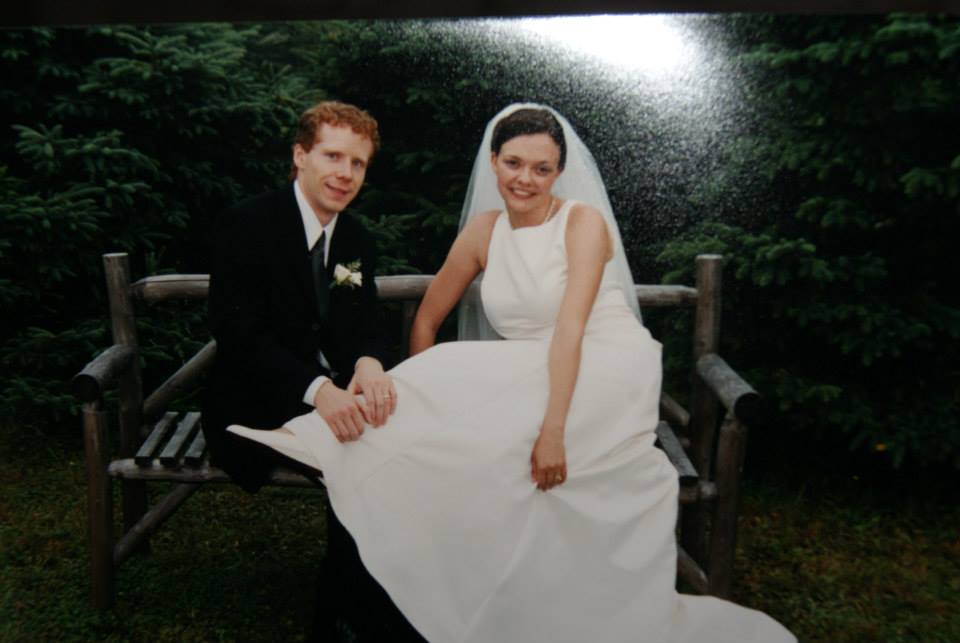
Dallas and Leanne Friesen wedding August 27, 2003

Well I’m in a bloggy-mood this week! 

As I mentioned yesterday, today is my 11th Anniversary.  As I enjoy the well wishes and likes of statuses on Facebook today, I found myself thinking about what I would say to Eleven-Years-Ago-Leanne about marriage and all the things she didn’t understand.  The list is very long – but, knowing her, she wouldn’t have listened too much and would have had to figure most things out for herself.  In my experience, this is true of most newlyweds and that is absolutely fine.  It’s part of what makes the journey of marriage fun.   All that to say, I was going to do an “Eleven Thoughts on Marriage on an Eleventh Anniversary,” but instead decided that I would just pick one thought and pass it on to any of you out there who might find it worthwhile. Here it is:Sometimes, you just gotta buy a door hook. 

Let me explain.

So Dallas and I have had lots of fights during our 11 years – some over serious things, and some over very un-serious things.  But, as most of us know, the un-serious things can add up to something bigger than you ever thought when you live with someone for eleven years straight.  One of our un-serious and ongoing – shall we say? – disagreements involved the daily placement of Dallas’ wet towels.

Every morning Dallas gets a shower.  And every morning he uses a towel. In our first apartment, Dallas would often leave said towel on the bed: NOT my favourite.  This led to many – shall we say – discussions –   but rarely to the towel not being left on the bed. Then we had a hiatus from the great towel dilemma.  We moved into our first house, and Dallas would hang the towel on a hook on the back of our bedroom door. Then we moved again, and there was no hook on our bedroom door.  Dallas began to leave his towel on the foot board of our bed. This drove me even MORE crazy.  Yes, it wasn’t technically on the bed, but, as I liked to (often) point out:  “The wet towel is going to warp the wood of our footboard!”  And as Dallas liked to point out “There’s nowhere else to put it!” So that’s where the towel remained.  I didn’t mention it too much anymore.  It wasn’t a big issue.  But that wet towel always annoyed me.

Then a couple of years ago I audited a Marriage Counselling Course.  One day the professor wanted to illustrate a type of dialogue and asked if someone who was married would volunteer to talk about an ongoing disagreement – that wasn’t serious – in their marriage.  I volunteered and I talked about – you guessed it – the WET TOWEL. 

As an aside here, let me say this: counselling can be a very very good thing.  I don’t remember what technique he used exactly but as he got me to share about our towel saga, I was able to acknowledge a few very important things:  1. Dallas is actually a very helpful and considerate person (he cleans our bathroom EVERY WEEK!) – the towel is not an attempt to drive me insane, 2. There is a reason that he does leaves the towel in our bedroom. When he takes it off, he does not want to walk naked to our bathroom to hang it up – and then he just forgets, 3. This was only a problem in our new house, because there was no hook on the back of our bedroom door. 

And then I realized – and shared with joy with our class – I COULD JUST BUY A HOOK!

So I did.  I actually bought one of those over-the-door things with FOUR hooks. And we have had towel harmony ever since. (And, yes, I should have figured this out sooner).

In conclusion, this is what I would tell newlywed Leanne of eleven years ago:  most things that you are going to think are huge deals just aren’t.  They aren’t a sign that your husband doesn’t care, they don’t require a lengthy analysis of the state of your union, they aren’t indicative of deeper problem.  You will have disagreements and struggles simply because you are two different people trying to share a life and no matter how much you love each other, you won’t always agree.  And sometimes, you can just buy a door hook.

These days I do a lot of pre-marital and marriage counselling for a living. I can’t tell you how often I sit across from a couple that loves each other and feel heart-broken at the things that they have allowed to turn into huge tipping points in their marriage.  Yes, I know little things can add up to huge issues, and sometimes that needs to be discussed. I’m not saying that you should overlook important issues or bury your feelings.   But sometimes we just have to accept the other person for who they are. Sometimes we have to accept that not everything has to be a big deal.  Sometimes we have to suck it up and buy a hook because that’s just what needs to happen.   I am certainly awfully thankful for all the “hooks” that Dallas has given me in the last eleven years because heaven knows I have a whole lot of my own wet towels.

Happy Eleven, Dallas. Thanks for the hooks.