Why I Am Not Wearing My Engagement Ring (And Other Thoughts on Lent and Dying)

I always talk about following Jesus as the way to life, and I believe that deep down in my bones.  I also know deep down in those same bones that the way to this life often starts with death – as annoying as that can be.  The last couple of years of my life have been a season with much dying for me.  I’m not talking about the death of loved ones, but the death of things that distort the true purpose of my life.  Ironically, even though they are things that harm me, they are things that I often hold very dear, and letting them die is not always easy.

Dying to Proving Myself

For example, one thing that I had to die to in recent years was the idea that I could do everything myself.  When my husband, who had been my co-pastor for ten years, started another job, we didn’t hire someone for his position right away.  And you know what I said about this?  (I laugh as I remember):  “I am really excited at this opportunity to prove that I can do this on my own.”  And I meant it!  I relished the challenge of showing what I could accomplish all by myself.  

This was not how things turned out.

Instead, those months involved a whole lot of me learning that I need help. Things didn’t always go well. I was not always equipped.  I did not have all the gifts and skills on my own to make everything work.  It felt awful – because I was dying.  Slowly, God was inviting me to die to the need to prove my independence.  This was not so that I could be humiliated or feel insecure – it was so that I could live!  The reality was that trying to prove how competent I was all the time was not fun.  In this season, God invited me to die to my working so hard to prove my worth, and live in something better:  dependence on God, and shared life in a community of people that are God’s gift to me.  When I stopped grieving not being able to do everything on my own, I saw and rejoiced in a better way – dependence, trust, and life. 

Dying Again

This brings me to today, and the ways I’m still learning to die, which is particularly fitting to consider this time of year.  On the church calendar we are in the season of Lent.  Lent is the time leading up to Good Friday and Easter.  Traditionally, it is a time to contemplate our own deep need for God, and to name and lament the things in life which cause us pain and death.

One of the ways we can live into this truth during the season of Lent is through giving something up.  In the past I have given up meat or soft drinks.  Some people give up chocolate or social media.  This year, I asked myself an honest question:  To what do I need to die?  And I decided that for the 6 weeks of lent I would not wear jewelry.

This is going to sound like I have very valuable or high end jewelry, which I don’t. It may also sound like I’m really into jewelry, which I’m not.  However, I do wear jewelry most days.  I like to wear big hoop earrings and chunky necklaces.  In fact, most mornings, after I get dressed, I take a few moments to “decorate” myself in jewelry.  Since the first day of Lent, I have skipped this phase of getting dressed each morning, leaving on only my watch (which I generally need for work) and wedding ring (I mean, I don’t want to get the hopes up of single men who may meet me and see me without one… It’s important to be considerate). 

Why would I do this?  Because of something to which I think I might need to die. In the last few months, as turning the big 4-0 draws imminently closer, I realize that I am growing overly anxious about my changing looks.  Those deepening wrinkles and stubborn grey hairs bug me.  I find myself missing the careless ease of how I looked in my youth, and putting more work into my appearance.  A little more make-up.  A little more time choosing what to wear.  A little more money on creams and lotions.  A little longer picking out the perfect jewelry.

I decided that removing this one small part of my routine would remind me each morning that my looks do not need to be an identity marker for me.  It would remind me to remember that God tells me I am “wonderfully made.”  I admit that over the last four weeks, there are times that I feel incomplete.  I put on a certain shirt and think: “This looks so BARE without a necklace.”  Then I remember that it’s okay. I pause and thank God for my healthy, useful body just as it is. I look at the wrinkles and the white hairs spiking out  at weird angles (Question:  Why are the white ones so CRINKLY???). I let them bug me and then I let them go.  I am trying to die to the lies that tell me youth is more beautiful, that tell me wrinkles should be fixed and that tell me I need to decorate myself to look more presentable.  They aren’t true.  In dying, I am seeking, and finding life – life that is free (er) from worrying about how I look.

This doesn’t mean that I will never wear jewelry, or nice clothes, or put on make-up.  This hasn’t been about jewelry; it’s been a practice to remind me of something I was forgetting about who I really am.  For that reason, on Easter Sunday I will select some lovely piece of jewelry (even though likely bought from a yard sale or thrift store), and wear it with joy because Christ is risen  and I live in life, not death.  I will remember that with or without jewelry, wrinkles, or my original hair colour that I am still God’s. I will celebrate that my life has value because of whose I am, and be glad that I can wear lovely things without relying on them to make me lovely – or loved. 

I will celebrate that my life has value because of whose I am, and be glad that I can wear lovely things without relying on them to make me lovely – or loved.

I also know it won’t be the end.  Yeesh, this dying thing can grow a little tiring, I admit.  I will have more seasons where I realize I am holding something too closely that is not a way to life, and I’ll have to die again. The good news is that, while we pause and remember the alternative during lent, we are Easter people.  And Easter people LIVE.  Jesus promises us that death is not the story – it is always life.  

And You?

If you are wondering if you are living into something that does not lead to life for you, I ask you to consider where you feel despair, or hopelessness, or inadequacies.  Where do you say: “I’m failing at this!”?  Where do you say: “I wish I was more like…?”  Where do you hear voices say: “You’re not good enough…”? Those may be areas where you are not called to push and pull to hold something more tightly, but actually to let something go.  And it may be that in dying to them, you find life in something so much better.  

Even if it involves taking off your engagement ring.
“We Could Have Gone to Florida: The Weird Thing I Miss On What Would Have Been My Sister’s Birthday

Note: This piece was written three years ago, on the first birthday after my sister’s death.  It was unpublished until today, on what would now be my sister’s 52nd birthday. I still wish we could have gone to Florida.

Today my sister would have turned 49. It is impossible for me not to think of all the things that I miss about her today, all the things that I feel like I lost on that day back in May, the things that we were already losing on her 48th birthday when the cancer was slowly taking over.

Today I grieve that I cannot phone her on her birthday.  I grieve all the phone calls I could not make this year, and all the ones I will never make. I miss hearing her voice. I miss listening to her bustle about her kitchen as she told me about her day.

I miss going to the Village Mall at 9:00 p.m. just “for a little look around.”  I miss waiting for her to try on “just one more top.”

I miss venting to her.  I miss that person who understood exactly what it was that was driving me crazy.

I miss Aunt Roxanne. I miss her cards and messages to our kids. I miss the way she loved them so well.  I miss listening to her read them stories.  I can hear the echos of her voice in so many stories that I read to them, remembering just the ways she would have read them. She did the best dragon voice for the “Paper Bag Princess.” I miss her dragon voice.

I miss brainstorming with her.  I miss discussing what Ralph the Raccoon could talk about in Sunday School.  I miss analyzing a skit for music camp or a costume for the school play.  I miss her awesome ideas.

There is so much I miss – her laugh, her dimple, her joy, her love.

But today, what I really miss, is Florida.  Which is funny – because I never went to Florida with Roxanne.  I went to Florida when I was 15 with my best friend, and I liked it well enough. I never had a particular desire to go back.  And now I miss Florida very very much.

A few weeks before Roxanne died, I spent 10 days in Newfoundland at her home.  They were a whirlwind few days. Her health had turned quickly, and as people realized she was in her final days, the visitors never stopped.  She was no longer fully herself.  She was too tired, too exhausted from trying to get through each day. She was not up for sentimental conversations, even though everyone wanted to have them with her.   On my last day of that trip, I knew that I might never talk to Roxanne in a real way again.  I prayed for days about what our last conversation would be like.  I asked God to grant me the right things to say. There was so much to say.  And I’d already realized that those “last conversations” rarely happened in the way movies tell us.  You know the scene – where the dying cancer patient is somehow well enough and coherent enough for a heart felt good-bye before slipping away peacefully while wearing Christmas shoes?  Yeah, having been at a few deathbeds in my profession, I can tell you that doesn’t actually happen that way very often.  Like so many other terminally ill people, Roxanne just didn’t have it in her for those kind of talks over and over with everyone who wanted them.  But I did hope that I at least could have some time alone with her, a few moments just to connect together.

She was actually well enough to sit in her living room for a few moments on that last morning before I returned home.  Her husband was out shoveling snow.  And there we were with our few moments alone together.  We talked a little bit about how she felt about things. She shared again that she was at peace.  We chatted a little more, and it was obvious she wasn’t in the mood for another heart wrenching good-bye.  Then I found myself blurting out: “Roxanne, it just really makes me sad that we won’t get to be old ladies together.”

And she smiled a little and said: “We could’ve gone to Florida.”

It still brings tears to my eyes to remember it.  Not because it was a sad moment – but because it was true!  In that moment I could picture us as two old ladies – because after a certain age 13 years of age difference isn’t noticeable anymore – gallivanting in Florida.  Going to outlet malls.  Wearing big hats.  Eating at a lot of restaurants.  All of Roxanne’s favourite things. And I can assure you that old lady Roxanne in Florida is just about one of the most fun things that I can picture.  I can assure you that THAT would have been one great vacation.  Or perhaps yearly vacation.  Oh, how I would have loved to have gone to Florida with old-lady Roxanne. How I would have loved to be old ladies together. How I would have loved to be ladies still hashing things out on the phone, still discussing whether a new top really suited us, still hunting for a bargain.  How I would have loved to hear Roxanne planning a party for the Seniors group at her church.  How I wish it had been able to happen for us.

It probably sounds silly that, with all the things I grieve, that I grieve for Florida.  I grieve for a trip that never happened, but the image of which in my mind is as clear as if it happened yesterday.  I grieve for all the things that won’t be.  I grieve that we never will be old ladies together.  I grieve because 48 years were good – but they just weren’t enough.

Because we could have gone to Florida.


“Maybe a Senior Pastor: Why Seeing Women in Ministry Matters

I can’t tell you how many times I have spoken at a church or event and had a woman tell me afterwards:  “This is the first time I have ever heard a woman preach.”  I’m never quite sure how to respond. I usually say something like: “I’m glad you could see that.”  Then I leave the conversation with a mixture of sad and happy feelings.  I’m happy that they’ve seen for the first time a way that God uses women; I’m very very sad that they’ve never seen it before.

I have been a pastor for nearly 15 years, and I keep thinking that maybe we have turned a corner so that I can stop being an anomaly for so many people. However, while things continue to improve, I know in my heart that the corner is still there.  I know that when I speak at many events that I don’t speak only as Leanne, or as the pastor of Mount Hamilton Baptist Church. I speak as a woman. I speak for all women pastors and leaders and teachers, whether I like it or not.  

Sometimes it feels like a big weight to bear, to carry the task of “proving” that God calls women to serve in a role like mine.  Sometimes I try to downplay in my mind how significant it all is – “I’m just doing what I always do,” I think to myself.  But then a woman taps me on the shoulder and says some version of: “Thank-you for showing me a woman can do this,” and I remember. I remember how important it is that what I do is seen and known and heard and processed – especially to young women.  Sometimes I need to remember again that it matters that young women see women in ministry.

Let me tell you a story.

This summer my husband and I served together as teachers at a teen camp.  One evening, I attended the annual “Girl’s Night” for the women and staff.  Over snacks and pedicures, I chatted with a few of the staff and campers. They had many questions for me.  “So, you’re the LEAD pastor of your church, right?”  (“Yes I am.”) “Do you preach every week?”  (“Most weeks, yes.”)  “What did you do when you had children?” (“I took maternity leave, like other working women.”)   

The responses went like this:

“That is SO cool.”

“I’ve never seen that before.”

“I wish our church had a woman pastor on staff.”

(Then, because I could, I had to add:  “Actually, guess how many of our 3 pastors are women?…ALL OF THEM!” They really loved that. One girl poked her friend…”Did you hear that?  All of the pastors on their staff are women!! Isn’t that awesome??”).

One young woman in particular had lots of questions for me, because she also felt called to ministry.  She was intrigued, and excited, to learn that I was the Senior Pastor at my church, because she’d never met a woman senior pastor before. She explained to me that she was in her last year of Bible College, and was planning to pursue a Master’s degree in ministry and become a youth pastor.  I encouraged her in this call, certain of what a gift she would be to the Church.

Now let me tell you the really good part.

On the last day of camp,  I happened to overhear a conversation between another adult and this same young woman.  She was explaining her plans for her future.  “I want to be a youth pastor,” she said, as I expected to hear.  But then I got an unexpected surprise, when, after a little pause, she added something she hadn’t said before:  “Or maybe a Senior Pastor,” she said.  

Maybe a Senior Pastor.

My heart soared!

Now, I don’t know for sure if my presence over that week had anything to do with this. What I do know is that earlier in the week she had shared one option for her ministry, and that after a few days of seeing a female lead pastor teach, she added a new “maybe.”  I believe that “maybe” wasn’t only about a certain job.  To me, in that maybe, I heard: “Maybe God can use me for any role in the church.  Maybe I can trust God for anything.  Maybe there’s more than one option for me.”  

Let me tell you this: I want more of those “maybes” for young women in the church. And then I want all those maybes to turn into certainties – certainties that God can call our young women to any role, any calling, and that they can say “yes.”

How does it start?  It starts when they see women who are doing it.  This means that it matters that young women see women in ministry.

Churches and pastors…does it matter that you make an effort to include women in your teaching rotation, to have women on your boards, to let them share in your service?  

Yes.  

Conference, retreat, and event organizers…is it important that you look for those women speakers, even when you may have to look a little further? Is it important that there are women up front, fully participating and leading?

Yes.

Women pastors…does it make a difference when young women see us and hear us serving as we are called (even though it feels a little unfair that we too often have to represent all women when we are simply following our own calls)?

Yes.

Young women need to see women in ministry.

This weekend my husband and I spoke at another youth event.  The event was for a denomination that affirms women in ministry, and so a woman speaker was not a stretch for them at all.  Yet, young woman after young woman came up to me:

“You’re the first woman I’ve seen preach.”

“I didn’t know women could do that.”

“Thanks for reminding me God can use me.”

My sisters, I’ll keep speaking and being here until all your “maybes” turn to “yeses.”

speaking


January Blahs and Epiphany Wonder

This morning I thought: “I don’t know if I can make it to the end of January.”  It was 8 a.m. and there was not even a sliver of sun to be seen. It was cold.  It was dreary. The kids were wound up and stir crazy.  I was still sniffing and coughing from my lingering winter cold, and the forecast warned that it was going to snow.  I felt defeated. The day ahead seemed very very long, and the night to come, I knew, would only feel longer.  It was just so…January.    

Every year I find January long, tedious, and depressing.  I say this even as someone who loves to ring in the new year and who celebrates her birthday early in this month.  These things I like. The problem is that somehow there is still so much January left after all of this stuff happens (doesn’t New Year’s already seem like eons ago???), and knowing there is still three weeks to go in this wretched month makes me want to crawl under the covers with a good book until Valentine’s Day.  

Last week, on a particularly frigid day during this cold snap, I had to park in a public parking lot.  When I drove up to the ticket dispenser, my window wouldn’t open because IT WAS FROZEN SHUT (I write this in all caps because it must be yelled). As I wedged myself around my car door to get the ticket, with a line-up behind me and my eyelashes freezing to my glasses, I cried out to the universe at large: “Why? Why do I live here?”

And I didn’t mean this country or this city or within this particular weather system, but really why HERE, in this time, this moment, this month?  In January?  In truth, the time in which we find ourselves can be as difficult and hard to negotiate as any space, and there are times and seasons where it seems the most helpful option would be to press fast forward and skip it all together.

Get out of January and into spring. Skip the struggle of learning and get to the joy of knowing.  Bypass the grief and get to the healing.

But this is where and when I am, and neither are without their purpose.  Interestingly, it has been a practice of time that has reminded me of this truth this month, and that has been pushing me out the door each day even when it’s -25 outside.  

Some of my readers will know that for centuries the church has had what is called the “church calendar.”  This calendar highlights important seasons and days in the Christian faith, and includes far more than the standard Easter and Christmas with which we are all most familiar.  As I wrote about in my last post, for example, the season leading up to Christmas is known as Advent. It is a season of waiting.  Usually, after Christmas arrives, I don’t look at the church calendar much again until Lent (the season leading up to Easter) begins.  This year, however, I studied a little more, and found myself greatly challenged by the remembrance of Epiphany.

Epiphany on the church calendar falls on January 6 (although there are traditions that honour this, and other holy days, two weeks later), and it is the day that we remember the time when the Magi (or three kings, or the wise men, as they are sometimes known) came to see Jesus.  This is considered the first great “manifestation” of Christ – that Christ is revealed to these men, and, more broadly speaking, to those outside the Jewish faith.  It is an indication that Christ had come for the whole world. Epiphany is a celebration that God makes God’s self known.

After January 6, there are some traditions which continue to celebrate the weeks to follow as a continued season of “Epiphany,” and there are those which will mark each week in January as a certain week “after epiphany.”  There are also many traditions, including my own, which don’t really talk about these seasons at all.  The church calendar, after all, is not a biblical teaching. However, it is a church tradition that reminds us of the importance of many Biblical stories and also calls us to enter into the life of faith in a tangible way with the passing of each new season. This, I believe, is a gift we can sometimes miss in some of our traditions that use the church calendar less than others. 

For many years, although I knew what it was, I missed Epiphany. I missed the invitation to see this season as a time to look for God’s revelation. This year, I’m glad to have heard the invitation more clearly.  I know that when the church calendar was constructed that no one involved in it had any idea of what a cold Canadian January could be like, or how desperately a January-weary Canadian woman would one day need to remember this season.  But I sure do need to know this month in a special way that God is always revealing God’s self, and that, like the Magi, I can seek, and I can find.

So this January, despite my reluctance, I am trying to live into Epiphany. I am resisting the urge to hide, cover up, retreat, or complain, and embracing the call to look, listen, respond, and be thankful.  Already today God revealed His goodness to me in a kind gift from a friend, the encouragement of a timely message, and a nudge to contact someone I hadn’t thought of in a while.  Revelation all around …and three weeks of January still to go!

Do you join me in having the January blahs?  Perhaps God is also inviting you to choose Epiphany wonder over January woe. Like the Magi who followed a mysterious star, may you too see the signs of God around you and follow them towards Jesus.


I Need Advent

It has been a long, dark, loud November for me. This month has felt like a downward spiral from difficult to devastating, and the increasing darkness that comes with the longer nights of this month has well reflected how the world feels around me.  To be clear, it hasn’t been anything personal going awry in my life. However, as a living, breathing, person I have been unable to extricate myself and my feelings from the very heavy things going on in the world around me. They feel personal, even though I am nowhere near them.  I don’t live in the United States, or near Standing Rock, or in Syria, but these places are part of the world in which I live, and it is for the world that I have been grieving – a world that seems to be growing more angry, more hateful, more dangerous.

I have been silent on my blog this month, because the month has also been so very LOUD.  Sometimes I feel like the news and my Facebook feed is screaming at me: “It’s so bad!”  “It’s so hard!”  “All the things!”  I have felt the need to be quiet, which comes as much from not quite knowing what to say, as much as from a place of not wanting to be another voice saying something.

But today, I write.  I write to name something that is more real this year for me than perhaps any other year. I write to say that I need advent, and thanks be to God, I am so glad it is here.

I didn’t grow up with Advent being a big part of my life.  For me, Advent was nothing more than the cardboard calendar with boxes I could open each day with a piece of chocolate.  I did grow up with lots of excitement for Christmas, which has carried into my adulthood.  I am definitely a “Christmas person” and I love getting to the time when I can decorate the house, host the parties, and have my husband stop scowling when I turn on the Christmas music.  Culturally, this is, indeed, the “holiday season.”  The music is playing in the stores, the lights are up, the events have begun.  I love it! …And I need something more.

I need Advent.

Advent is part of the Christian calendar. You won’t find it listed on the calendars you get from  your gas station or the daytimers you buy at Staples.  But you will find it listed, with great importance, in books outlining Christian worship practices and lectionaries.  Advent is the season that leads up to Christmas, which is why those chocolate calendars totally get it right.  Advent is when we wait for Christmas, with anticipation not unlike children who are counting down the days each chocolate represents.

This may not sound like much worth remembering. After all, who likes waiting?  But this is not simply a looking-at-your-watch-waiting-for-your-turn-at-the-passport-office sort of waiting.  This is a hopeful, longing waiting.  It is waiting that admits that we are a people who have not figured it all out.  It is a waiting that acknowledges that we feel the darkness, and it is hard.  It is a waiting that says: “Come, Jesus” – because we need you.

I need this kind of waiting.  I need the space to say: “I am sad about what is happening.”  I need the space to lament. I need the space to want things to be different, to pray, and say: “God, send your light because it is dark.” I need to light candles of hope, peace, joy, and love. And I need the space to hope.  I need the space to remember, with advent, that Christmas comes.  That Christ comes.  That light comes.

Welcome, advent.  I’ve needed you this month.  

Come, Lord Jesus.  We need you, always.


If Jesus Kept Office Hours OR “No Thank-you to the Hamster Wheel”

Today I brought my daughter to the fracture clinic at our local children’s hospital for a final check up on her arm (she broke her elbow in September).  Her appointment was 11:15 and when I called to see if I could change it to later in the day to better work in my schedule, the receptionist explained that her doctor only kept office hours until noon.  If you’ve ever been to the fracture clinic, you will not be surprised to know that the clinic was packed when we got there and that we did not even get called into the doctor’s office until 12:30.  I didn’t mind – this was a shorter wait than we’ve had in the past, and I felt for the doctor and the pressure on his time. As I walked out and saw that there were still a handful of people left in the waiting room I realized that there was no way this doctor was going to be done seeing his patients until at least 1:00 or 1:30 – over an hour after his “office hours” were supposed to be done.

I thought about this doctor’s life. I wondered how often he worked over an hour past when he intended. I wondered if he had lunch plans that he had missed. I wondered if he had a family that had grown used to him being late. I wondered if he even felt he had the option of saying “no.”  

As a church community, we’ve been doing a series of teachings together that I’ve called “No Thank-you.”  We’ve been discussing ways that Jesus modeled saying “no” in his life.  This week I struggled to find the right words to articulate the topic of the sermon. I thought of “Jesus said no to busyness” or “Jesus said no to exhaustion” or “Jesus said no to exceeding physical limitations.”  What I landed on was: “Jesus said no to the hamster wheel.”

I’m guessing I don’t even have to explain what I mean by this.  Hamster wheels have become a common analogy for the way we often feel like we live our lives – running and running and running and not really getting anywhere.  We run from work to home to school to kids’ activities to the gym to the grocery store and back to pick up the kids again.  We are weary and exhausted from all our effort, but we don’t stop running until, like a hamster, we collapse in a corner to sleep –  until we get up to run again.   

Perhaps we wonder what choice we have. After all, what would all of us in that waiting room have done if the doctor came out at noon and said “Sorry – I’m done for the day”? Our cultural expectation is that we will have our needs met and our appointments kept.  If we keep running, other people should keep running , too.

Jesus, however, did not live this way. This is interesting because if anyone had reason to “run on a wheel” it was definitely Jesus.  This wasn’t an era with modern medical help and for many people at this time with illnesses and disabilities he was their only chance for healing.  If Jesus kept office hours, I have no doubt that he never would have had enough appointment slots. I am certain his waiting room would have always been full.  I guarantee that he could have worked through every lunch and coffee break and civic holiday.  I picture people glaring angrily at his disciples/receptionists as they ask: “We’ve been here an hour already. Do you have any idea how much longer this will be?” There would have always been more that he could do.

But Jesus didn’t live like this at all.  Although there were many times that he did respond to huge crowd clamoring for his attention, the Bible also tells us about many times that Jesus stopped.  We read about him walking away, taking breaks, having a nap, sneaking off in boats for some down time, and going to quiet places so that he could pray.  There was so much he could have been doing, but he said “no thank-you” to a hamster wheel sort of life.  While he lived fully into the calling God placed on his life, he also took the time he needed to renew his body and his soul.  This verse summarizes it well:

“…Crowds of people came to hear him and to be healed of their sicknesses. But Jesus often withdrew to lonely places and prayed.” (Luke 5:15-16)

Let me say it clearly: I believe God has something better for us than a hamster wheel.  Jesus said that he came so that we could have life and have it to the full.  I do not believe “full” meant a blocked calendar and a mini van with good gas mileage.  I think “full” looks a lot more like “spacious.” I believe Jesus wants to offer us  a life with space for rest and afternoons at the park and naps and leisurely walks and prayer and suppers at the table and the gift of being available.  I believe he invites us to say “no thank-you” to the hamster wheel, so that we can really live.

That’s why, if Jesus kept office hours,  I think he would have taken a lunch break (remember the feeding of the 5000?).  I think he would have inserted slots in his agenda for time with His Father (“I know it’s busy, Pete, but that time slot is non-negotiable”).  I think he would have made people angry sometimes when he declared he was done for the day even if there were more people waiting. I think he would have taken his vacation days.

Listen, I’m thankful that my doctor didn’t make me wait any longer to treat my daughter.  But I also hope he’s not too tired tonight. I hope if there was someone waiting for him for dinner that he made it on time, and that he got to sit and listen slowly to any story someone who loved him wanted to share.  I hope that his week will be full of times when he gets off the wheel.   I hope he knows I wish this for him, even as I wish it for myself – and for you.

No, You May Not Throw Me Off a Cliff

I’m going to start this post by telling a story about Jesus.  Even if you are one of my readers who is not into Jesus, I hope you will keep reading because I think the message of this post is so important.  The message is this:  “You can say no to people who want to throw you off a cliff.”

What cliff?  – you might ask.

What people? – you might ask.  

Stick with me, and it will make sense soon.

First the story about Jesus.  It is a bit of an odd one, which is one thing I love about it.  One day Jesus returns to his hometown and is invited to participate at the synagogue (kind of like someone being asked to participate in the service when they return to the church in which they grew up). Jesus reads from Scripture, and when he does, all the people are amazed.  They are excited about what he has to say, and it is clear that they are feeling hopeful that he may be a prophet or even something more.  As they sit in awe, however, Jesus challenges them.  He tells some stories that imply that God’s saviour is not going to only be for their people, but also for those that are not Israelites.  He suggests that the fullness of God’s story would ultimately include everyone – which meant a whole lot of people they did not like.   

This is not regarded as good news.  

In fact, the crowd grows so angry that they basically form a lynch mob.  They drag him out of the synagogue and take him to the outskirts of town, and push him to the edge of a cliff.  This is where executions happen, and their clear plan is to put an end to Jesus then and there by throwing him off.

This is a terrifying moment to picture.  Here is Jesus, surrounded by friends and family he had known since childhood (remember he was in his hometown),  and now the whole town is facing him down, ready to fling him over the edge.  What can he possibly do?

I’ll tell you what he does, and I have to say it is awesome.  To quote the Bible: “But he walked through the crowd and went on his way.”

When a crowd of angry, afraid, self-righteous, infuriated bullies is ready to toss him over a cliff, Jesus says: “No.  You do not get to throw me off this cliff.” He walks away.

As we continue to talk at our church about times to say “no,” this story reminds me that one of the times that we can say “no” is when people want to throw us off a cliff.  This is profoundly important, but easily forgotten.

“Cliffs” can look like a lot of things. For you, a cliff might look like a relationship that constantly pushes you to the edge – one that demands and demands, and takes so much that you feel you are close to the tipping point of not being able to take anymore.  A cliff might look like a leader who belittles and shames you and makes you feel inadequate so that you begin to wonder if you should even continue in your role.  You might be on a cliff if you find yourself saying: “Maybe I’m not cut out for ministry after all.”  “Maybe I’m not good enough for this job.”  “Maybe I should throw in the towel.”  A cliff might even be someone who claims to love you that tells you that you are ugly or unlovable or not capable of being more or only good enough for certain things or obliged to fulfill the roles they see you filling.  

I talk to people all the time who are on the edge of cliffs they don’t even recognize.  They have been pushed and shoved and cornered so long that they have begun to think it is normal.  They are captive to another person’s definition of their value.  They don’t see an “out.”  They falsely believe that they deserve to be on a cliff.

This is where I want to say something very important:  Nobody deserves to be on a cliff.  I’m not saying we never do things wrong, or that we are never right to be challenged, or that hard relationships are always bad ones.  I am saying that even at our very worst, being held hostage at the end of an emotional cliff is not a valid, helpful, or godly response. What leads people to bring others to cliffs? It is not love, or health, or hope.  It is usually fear or insecurity or the need for power and control.  That’s what it was with the crowds and Jesus.  The people were scared.  They were afraid of what Jesus had said, and to deal with their fear they decided Jesus had to go.  

It was the wrong response, and it is always the wrong response.

That’s why Jesus said no.  No –you don’t get to do this to me.  No – I will not let you tell me who I am.  No – I will not let you decide how this story goes.  No – you do not get to throw me off a cliff.  

We can do that, too. If you sense that you might be in a situation or a relationship where you have been dragged where you don’t belong, consider these three steps:

Recognize the cliff

It can be really hard to acknowledge that we have been manipulated or harmed or misused by another person.  We don’t want it to be true.  Especially if it’s someone we love putting us on that cliff, we can spend a lot of time justifying their behaviour.  “Oh, I’m not on a cliff.  This is actually just a nice escarpment.  I kind of like the view.  I don’t mind heights.”  That’s why step one is naming things for what they are: “This is a cliff.” “This is harming me.” “I don’t want to be here.”  

Remember that you don’t deserve to be on a cliff

As I’ve already said, no one deserves to be on a cliff.  You may find yourself wondering: “Is it my fault?”  You may wonder if you should have acted differently, or done things differently, or been a different person in order to somehow prevent your abuser from shoving you so far.  No.  A cliff is the result of someone else’s bad behaviour.  Every person is worthy of love and respect, because God tells us so.  This includes YOU.

Say “No thank-you.”

It can take a while to get here.  It may not happen right away.  But when you recognize the cliff, and when you remember you don’t deserve to be there, the next thing to do is walk away from the cliff.  This can look like a lot of things.  It can look like refusing to listen to the lies someone wants to keep telling about you. It can look like letting a text or a phone call go without responding as you learn to set boundaries.  Like in Jesus’ situation, it can look like physically walking away.  It always looks like saying “no.”

Why do we have to say no?  Because if we don’t, we may get pushed off the cliff.  The damage can become so great that it can shatter us. I promise this not God’s plan for you.

Let me end with an invitation:

If you are teetering on the edge, picture God, who loves you, on the other side of the crowd. Picture God with an open hand, inviting you to a different place – where you are safe, valued and loved.  Your accuser will try to stop you and hold you back, but remember you can say “no.”  You can holler: “YOU CANNOT THROW ME OFF THIS CLIFF!”  And you can walk to something new.

“No Thank-You! Saying No, Even When It’s Really Good Stuff

I often struggle to say no.  Not always – there are some instances where I find saying no a cinch. For example: “Leanne, would you like to go on a run?”  My response? “No, I would not.”  Or: “Leanne, can you help me fix my computer?”  My answer: “No, that is not something I will be able to do.” I can also assure you I will easily say no if you ask me if I want to watch a horror movie, wear a strapless dress or attend a Gospel Coalition conference.

But other times no is very hard for me, in particular if I can see a need where I can help or if it is a good opportunity for ministry.   Leanne, would you like to speak at this event? Serve on this committee? Meet someone for coffee going through a difficult time?  Would you be free to help with this project, because we are really short on volunteers?  Could you step in because someone else stepped down?  I respond to emails and phone calls on my days off.  I agree to things and instantly wish I hadn’t.  I find it hard to say no because there is so much need, and I don’t want to be a jerk, and I want to be faithful to God.

This is particularly hard as a pastor, because there is always need around me.  There are always people who have a ministry they want to tell me about, or ask me to promote.  There are always people who are struggling, always another phone call I could make, another meeting I could attend, another message I can answer to assure people they are important to me.  I wonder:  Is it really okay to say “no” to people who need help, to good things, to mission and ministry and all the valuable things that can happen through them?

According to Jesus, the answer to if I can say “no,” is “yes.”

We read a story that illustrates this in the Bible.  It’s shortly after Jesus has begun to teach and lead and heal people.  One day he goes to a place called Capernaum and while he is there word about his miracles starts to spread.  It says that in the evening crowds gather around the house where he is staying so that they can receive healing from him.  There are so many people, and so much need, and he spends the evening responding.

But the next morning Jesus does something interesting – he goes away quietly by himself, and he prays. His friends look for him and when they find him they exclaim: “Jesus! Everyone is looking for you!”  

You can hear the urgency in that statement, and all that it implies.

There are people that want healing!

There are people that need help!

There is so much to do – how can you be here resting by yourself?

Man, that’s how I feel sometimes.   There is so much that could be done.  It’s like a voice saying to me: “Everyone is looking for you!” And if I was Jesus in that situation, I probably would have booked it back into town as fast as my sandals could carry me.

It’s not what Jesus does. Instead, Jesus say:  “Let us go somewhere else…so I can preach there also. That is why I have come.”

You read it right. He leaves.

He doesn’t jump up and run back and say “I’m so sorry!  I know you needed me!  I shouldn’t have left!”  He doesn’t say “I better get back there because there’s no one else that can do this!”  He doesn’t say “Yes!”… He says “No.”  

There is a reason for this.  Jesus wasn’t called only to Capernaum.  He also wasn’t called to spend His time on earth serving as a medical guru as people would demand of him.  He had come to proclaim the Kingdom of God.  He had a mission and a time frame, and while he was in a human body he would have to work within those limitations.  This meant that to live the fullness of His purpose, He couldn’t do it all.  Sometimes He would have to say “no.”  

Even when there were whole crowds waiting for him.

Even when what they wanted were very good things.

Even if people would be disappointed.

How did he do this?  If we look in the story, we see that it starts with prayer.  It was after spending time with the Father that Jesus could discern what was next for him.  When he knew the next step (going to another town) he could say “no” to what would distract from that (following the crowd’s demands).  

I once heard someone say: “The only person without a Messiah complex was Jesus,” and it made me smile.  If Jesus can say “no,” even to the good things, surely we can as well.  There will always be crowds. There will always be more good to do.  There will always be people asking us to save them.

Our task is to prayerfully sense how we can follow God’s purposes so that when we are being pulled from that – because we don’t have time to do it all, or because we need a rest before we burn out entirely, or because our hearts are growing cold as we stretch them too far – to say, with love “No, thank-you.”  

It is not saying “No, you’re not important.” It is not saying “No, this doesn’t matter.”  It is not saying “No, I don’t care.”  It is saying: “No, this isn’t what I am called to do/able to do/have been gifted to do.”  It is being faithful to a bigger purpose, and it is good.

If saying yes means you will be overextended, distracted, angry, scattered, ineffective or exhausted you are not doing anybody any favors.  Sometimes the best work we can do for the Kingdom of God begins by saying “No thanks.”

If you would like to receive updates on new posts to this blog, click the “follow” button on the side of this page and you will receive an email alerting you to new posts.  

“You’ve Got to Go Through It…” Why We Can’t Go Around Grief

One of my favourite children’s books is the classic “Going on a Bear Hunt.”  You may have read it, but if not, let me give you a summary.  The book reads like a poem, or a song, with a rhythm and meter as you read.  The refrain is: “Going on a bear hunt, gonna catch a big one, we’re not scared!”  Then after each of these refrains we see this family on their bear hunt hit an obstacle.  For example: “Oh-oh! A forest! A big, dark forest.”  Then comes the important part.

We can’t go over it.

We can’t go around it.

We’ve got to go through it! 

Then we read sounds as we act out together going through the forest: “Stumble, trip, stumble trip.”

This continues with different obstacles. 

I have begun to quote this refrain often in recent years, to the point that the words have begun to feel almost sacred to me, as extreme as that might sound.

Can’t go over it!

Can’t go under it!

We’ve got to go through it. 

I have said them at funerals, hospitals, in coffee shops, and in my office while passing over a box of tissues.  I say them to people who are grieving, and I believe them.

I say them because we have become a grief-avoidant culture.  I see this everywhere, and it saddens me.  A common example: “We don’t want the funeral to be sad.”  Or even: “We don’t want a funeral at all…it will be too hard on everyone.”  

Sigh.

How did we come to believe that by avoiding something we would somehow be able to skip it?  

There are other things too.  We tell grieving people it’s time to move on, or we encourage them to distract themselves, or make them feel embarrassed if their emotions linger a little bit too long. There is the common refrain from the broken hearted after a loss: “I don’t want to have to do this.  This hurts too much.  Can’t it just get better?”

This is where I quote one of my favourite verses of Scripture, when Jesus said: “Blessed are those who mourn, for they shall be comforted.”  Amen and amen.  Jesus doesn’t say “Blessed are those who don’t feel sad.”  Or “Blessed are those who get over it.”  He says: “Blessed are those who mourn.” Mourning is blessed because in it we find the comfort of God, and so starting with this verse is important.  

And then I add to it:  “Have you ever read “Going On a Bear Hunt?”…”

At first, they look at me a little strangely, until I remind them of the refrain of the story. Then they nod, because they begin to recognize in it the truth they are now experiencing.   

You can’t go over it.

You can’t go around it.

You’ve got to go through it.

The only way to the other side of grief (and this includes grief not only from the death of a loved one, but grief from any loss) is walking through it, though the journey itself is often rather twisty, turny, and occasionally leads you backwards.  We push and muddle our way through and and we also make sounds.  Wails. Sobs. Screams of anger at the injustice of it all.

The book might sound like this.

Uh-oh.

Grief.

Yucky, Sucky grief.

I can’t go over it.

I can’t go under it.  

I’ve got to go through it.

AHHHH!!

“I hate this!”  

“Why me????”  

Skipping grief won’t fix it.  I know you might want it to.  I know that it feels like there must be some path around it, some other way,  that surely someone has figured out by now a different road that you can walk that will spare you the crushing weight of loss and heartbreak.

I say this with love: There isn’t.  There is only going through it.  

It is not nearly as awful as it sounds.  Well, let me say that again – going through grief is awful…but what is not awful is what happens when you do. When you go through it, you get to another side.  You will arrive with scars and perhaps a limp.  You will be different, forever.  AND there will be healing and new life and the chance to walk forward again.  No amount of walking around or over or digging tunnels under grief will get you there.  Sooner or later you’ll just end up back at the start of grief and realize: “Yup, I’ve got to go through.”  

So, walk. Or crawl, if that’s all you can manage.  Lie down when you need a break.  Pack tissues.  Let friends who are willing come with you and hold your hand.  Cry.  Talk. Rage.  Pray.    

But whatever you do, don’t try to go over, or under, or around it.  And don’t expect it of others.  It won’t help.  Please, can we stop trying to skip grief? Can we stop with “This isn’t a funeral.  It’s a celebration!” – and let it be both?  Can we stop with “This will be too hard so we won’t…..” (fill in the blank here:  have a visitation, go to visit a hospital, say a person’s name, call someone who is grieving,  go to grief counseling, throw ourselves on someone’s shoulder and cry our eyes out….), if the only reason we aren’t doing it is to avoid the pain that is unavoidable? Can we stop with “Let me tell you how to feel better” and start with “Let me sit with you right in the middle of it?” Can we acknowledge that lament and loss and despair are not only a part of life, but a part of very real faith?

Say it with me:

I can’t go over it.

I can’t go under it.

I’ve got to go through it.

No bears at the end.  But comfort and healing and all the blessed things that are on the other side.   

Our Unlucky 13th Anniversary

A couple of weeks ago, my husband Dallas and I celebrated our 13th wedding anniversary.  Truth be told, we don’t always do anniversaries super well.  We got married at the end of August, and every year by the time our anniversary comes we are in the post vacation we-spent-a-lot-of-money-already-and-we-don’t-want-to-spend-more phase of the summer.  Still, we make an effort.

A couple of days before the big day I googled to see what kind of stuff was up in the city on August 27.  There was not a lot (another thing about the end of the summer!), but there was going to be a Flamenco Dance show at 8 pm at a local venue. That sounded like fun!  We got a sitter, and we planned for dinner and a Flamenco show.  Dinner would be at a nice restaurant we had tried last year on our anniversary and really enjoyed.  

Saturday came and we got ready to go out.  This was when we realized neither of us had made a reservation at the restaurant mentioned above – we called and discovered they were booked until 8:30.  8:30???  Who eats at 8:30?  What are we, 25?  We hummed and hawed about a backup restaurant.  We actually didn’t have a lot of time to make this choice since our sitter was coming at six and we had to get to the show for 8.  We picked another restaurant we liked downtown, left at 6 on the dot, found a parking spot and walked to restaurant choice #2.  

It was closed for vacation for two weeks.

So, we went to a chain restaurant within walking distance.  Not our favourite thing to do, but our options were pretty limited at that point.  The food was totally okay, and the musak playing in the background was tolerable.  

Off to flamenco dancing!!  

I should say here that we HAD tried at least two times to go online and buy tickets or to phone and reserve them, both to no avail.  When we checked online that afternoon it said we could buy tickets at the door.  But – you guessed it! – when we got to the door, they were sold out.  

By now, we were too late to go to an early movie and going to a late movie was not our cup of tea (a movie that STARTS at 10:00? What are we, 25?).  We had told the sitter our kids could go to bed at 9, and we were pretty committed to stay out at least until then.  I mean, most of the fun of getting a sitter is not having to do bedtime, am I right?

We decided we would go to the park we went to a lot when we were first dating and go for a walk.  Unfortunately, in my ambitious it’s-our-anniversary-and-I’ll-wear-something-special head space I had decided to wear high heels.  I rarely wear high heels (because I can’t wear them for any length of time without collapsing), but I thought I’d be fine since we were supposed to go to ONE restaurant and ONE flamenco show.  Wearing them on a walk meant that I spent the first half of our romantic walk limping and the second half walking barefoot and trying to avoid the goose poop.

The highlight of the walk was at the end of the night as we neared the car.  That was when, for the first time in our lives, we saw a real-life-honest-to-goodness SKUNK – about 10 feet away.  We both froze in place.  It seemed possible that on this night where everything was going wrong that getting sprayed by a skunk was a real possibility.  Then we saw a SECOND SKUNK.  It was on the other side of us, between us and our car.  WE WERE TRAPPED BETWEEN TWO SKUNKS.  We stayed very still for quite some time until we felt they were a safe enough distance away for us to make a break for it.  Then we ran/limped to the car and as I slammed the door I yelled “START THE CAR!!!” like the lady thinking she’s getting away with a deal in the IKEA commercial. (Aside: Did you know skunks attack each other? Because these did.  It was less romantic than it might sound). 

It was still only 9:00, and there was a chance our kids weren’t asleep yet, so we decided to go to a cafe that has great dessert.  To our surprise and relief, we were thrilled to see that it was both open and still sold dessert.  We shared a delicious piece of cake and laughed at what a gong show the night had been.   We agreed on one thing: the night of our 13th wedding anniversary was a lot like our marriage, which has gone nothing at all like we planned, but which makes us laugh a lot.  Also, we have had a really good time – not because it’s been perfect, but because we’ve been together.     

I am grateful…

As I thought back on thirteen years of marriage, the word that kept coming to my mind that night was this one: grateful. Thirteen years after saying “I do,” I am still profoundly grateful that Dallas chose to marry me. I am grateful that I get to be married to Dallas. I can honestly say that even on days when our marriage feels like a complete debacle I think to myself: “I am so thankful that this is the one with whom I get to share my life.”  

In my job, I get to talk to lots of married and soon-to-be married couples. Although I don’t profess to have a perfect marriage or all the answers about what makes a marriage a good one, my experience has given me some insights.  And the more I think about it, the more I think that a successful marriage begins in part with this: genuine gratitude that you get to be married to the one who is your partner.

It is sad that this is not always the case.  Our culture has bred a whole ideology that marriage starts with the OTHER person being grateful that YOU picked THEM.  People often talk as if to say: “I had sooo many choices, and aren’t you glad that I picked you?” You need to appreciate me!” “You need to be thankful for me!”   While mutual gratitude is of course essential, this type of language always makes me nervous. 

I smile when, instead, I hear someone about to get married sit across from me and say: “I feel so lucky that I get to marry him!” or “I still can’t believe she wants to marry me!”   

There it is! Gratitude.

I said this in one of our premarital classes too, and thirteen years later, I feel the same way. I feel like I hit the jackpot.  I feel like there was a lottery and I won it even though I didn’t buy a ticket.

Let me put on my amateur marriage counselor hat for a moment here and end by saying this: If you’re dating or getting married and you cannot say honestly in your heart that you feel gratitude for your partner, take a pause.  If you are more concerned with your partner knowing what a great deal they got with YOU – take a pause.  Or if you are marrying someone with that “Aren’t you lucky you got me?” attitude, take a pause too.   

Maybe those of us who are married should all pause – pause and think of the reasons we are grateful. Not for perfect anniversaries, or perfect partners, but for the chance to do life together as two imperfect people who love each other anyway, even on imperfect anniversaries.

Still next year, I’m making reservations.  Really, that stuff isn’t cute two years in a row – am I right?

For fun, here are a few shots that remind me of why I am grateful for Dallas.

  1. Double guns, obvi.

2. Mad jumping skills.

jumpingn-preggo

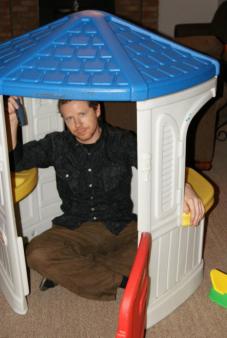
3. Construction Skills

playhouse

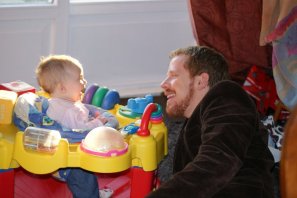
4. What girl can resist that smile?

lucy-laughs

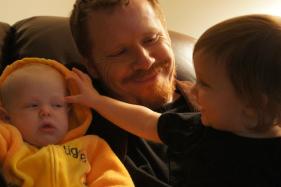
5. Eye crinkles that make my heart flutter

dallas-lucy-sloan

6. And that swanky red beard!  (fortunately I like white beards too)

couple-shot

Grateful. That’s me.